What is Kindergarten Readiness?
Kindergarten readiness is your child’s ability to thrive, not just get by, in a structured, social, learning-focused environment. This can be anything from adjusting to new routines, listening to directions, managing emotions, making friends and demonstrating a co-operative attitude about learning.
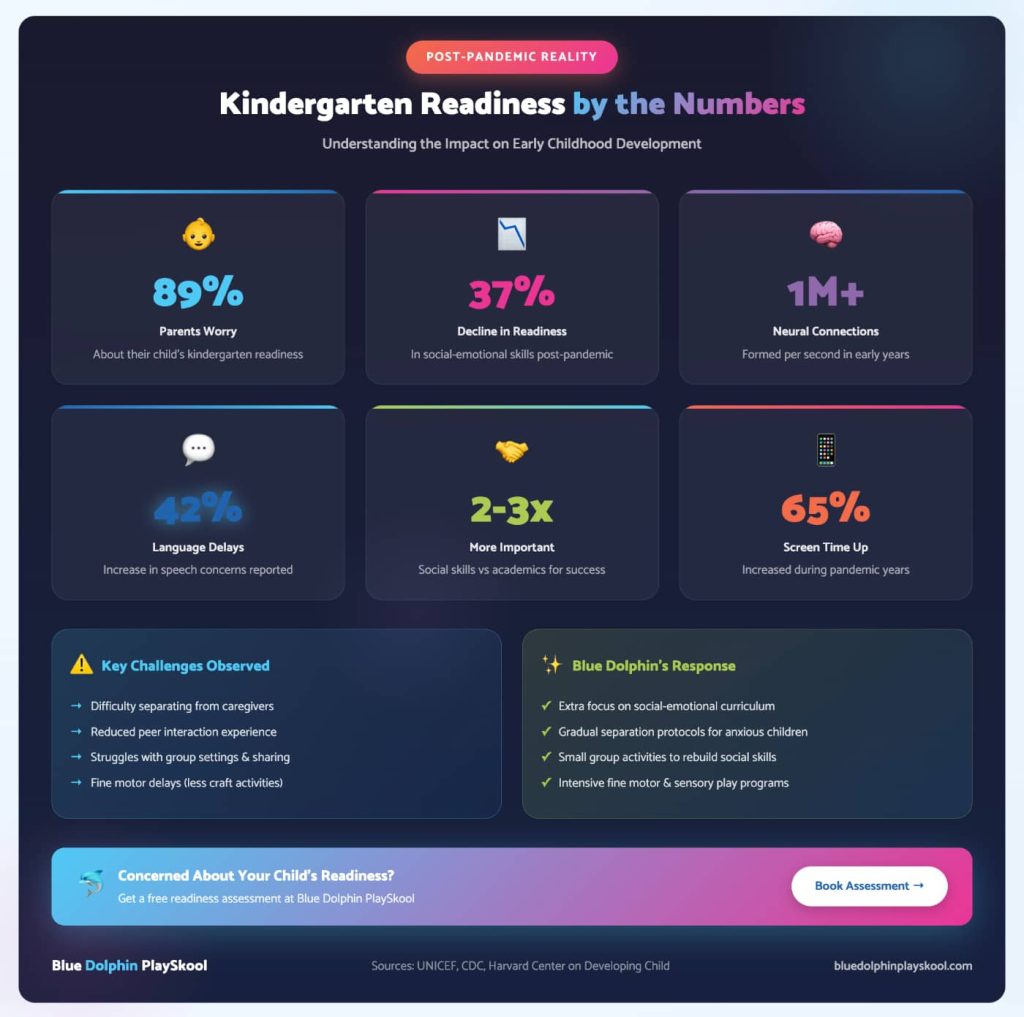
Studies reveal that 89% of parents worry in particular about their child’s preparedness for school. But here’s what most parents don’t realize: Kindergarten readiness isn’t about how well your child can memorize flash cards or already know the alphabet by age 4. Real readiness is much more complex, and, frankly, more significant than academic drills.
In a child’s early years, more than 1 million new neural connections form every second. These are the critical first years upon which all future learning, health, and well-being will be built.
Why Does Kindergarten Readiness Matter?
The Modern Reality of Kindergarten
Today’s kindergartners face:
- Extended periods of focused learning for 10-15 minutes at each time
- Greater behavioral demands, such as self-control and response to complex instructions
- Multiple social environments in which peer relations, sharing and cooperation are required
- Literacy and numeracy grounding in the academics
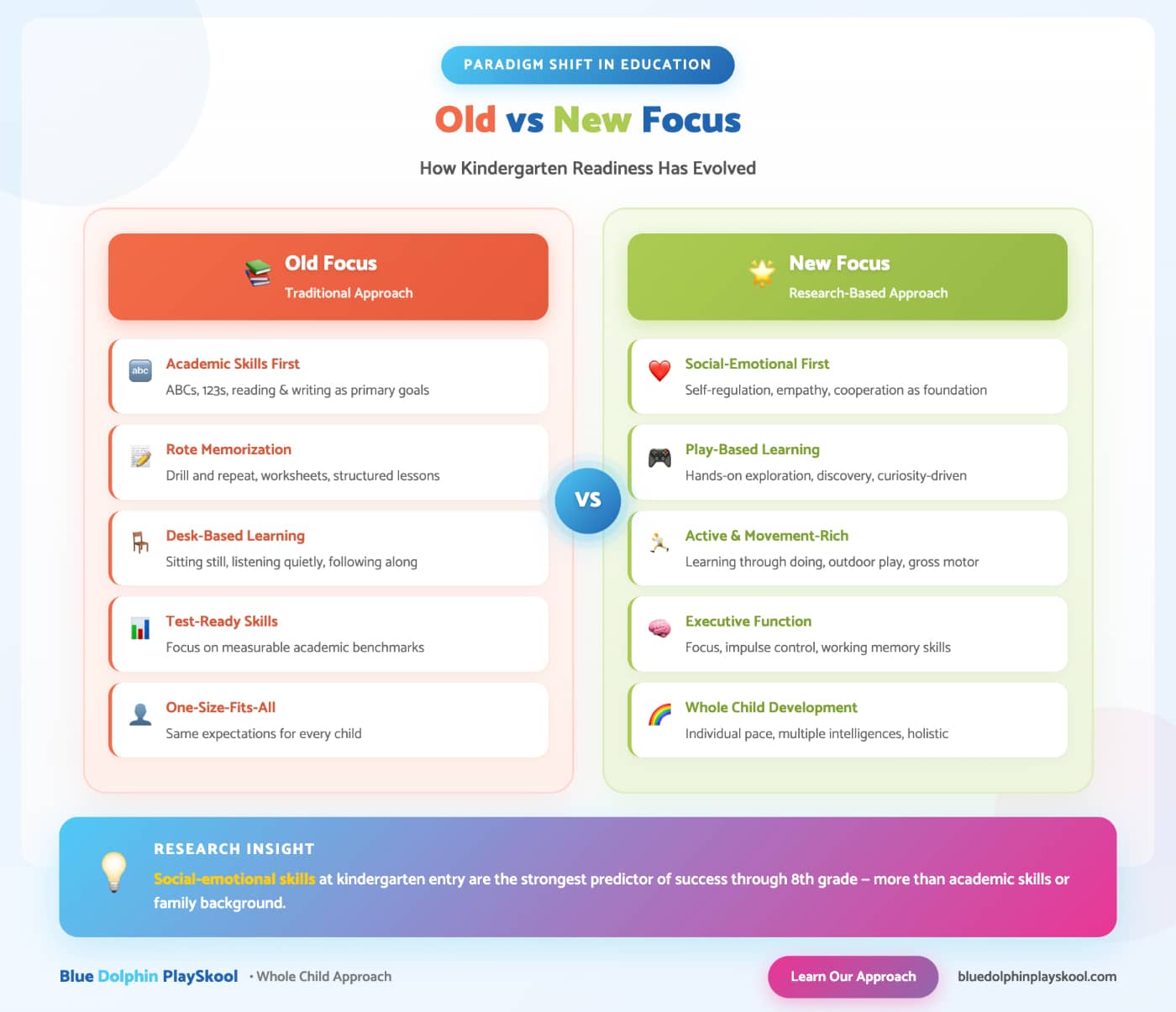
The Fundamental Change in the Idea of Education
| Old Focus (Outdated) | New Focus (Evidence-Based) | Impact on Success |
|---|---|---|
| Learning the Alphabet | Emotional Regulation & Self-Management | Predicts classroom behavior and resilience |
| Counting to 10 | Attentive Processing & Problem-Solving | Supports sustained effort in learning tasks |
| Identifying Colors/Shapes | Independence & Self-Care Skills | Smoothness of classroom routines |
What’s Changed in Readiness in the Post-Pandemic World?
The novel coronavirus (COVID-19) resulted in unprecedented early childhood development disturbances. Recent studies reveal concerning trends:
Cincinnati Children’s Hospital Study (2024):
- In 2021, only 30% of students were kindergarten-ready (versus 40% in 2018)
- That’s 7 out of 10 entering kindergarten underprepared
- The effects were even more extreme in deprived areas of the country
National Impact:
- 475,740 kindergarteners there were significant declines in language and cognition and social competence
- Teachers are seeing twice as many kids with developmental delays compared to before the pandemic
- 44% of PreK-3 teachers find potty training/bathroom independence is “much more challenging” than 5 years ago
The Good News: Brain neuroplasticity means that for developmental delays, there is always something that can be done about it when given the right support! The brains of young children are extremely adaptable. Through targeted activities and, when necessary, early intervention, children can make up for lost time.
5 Key Areas of Kindergarten Readiness
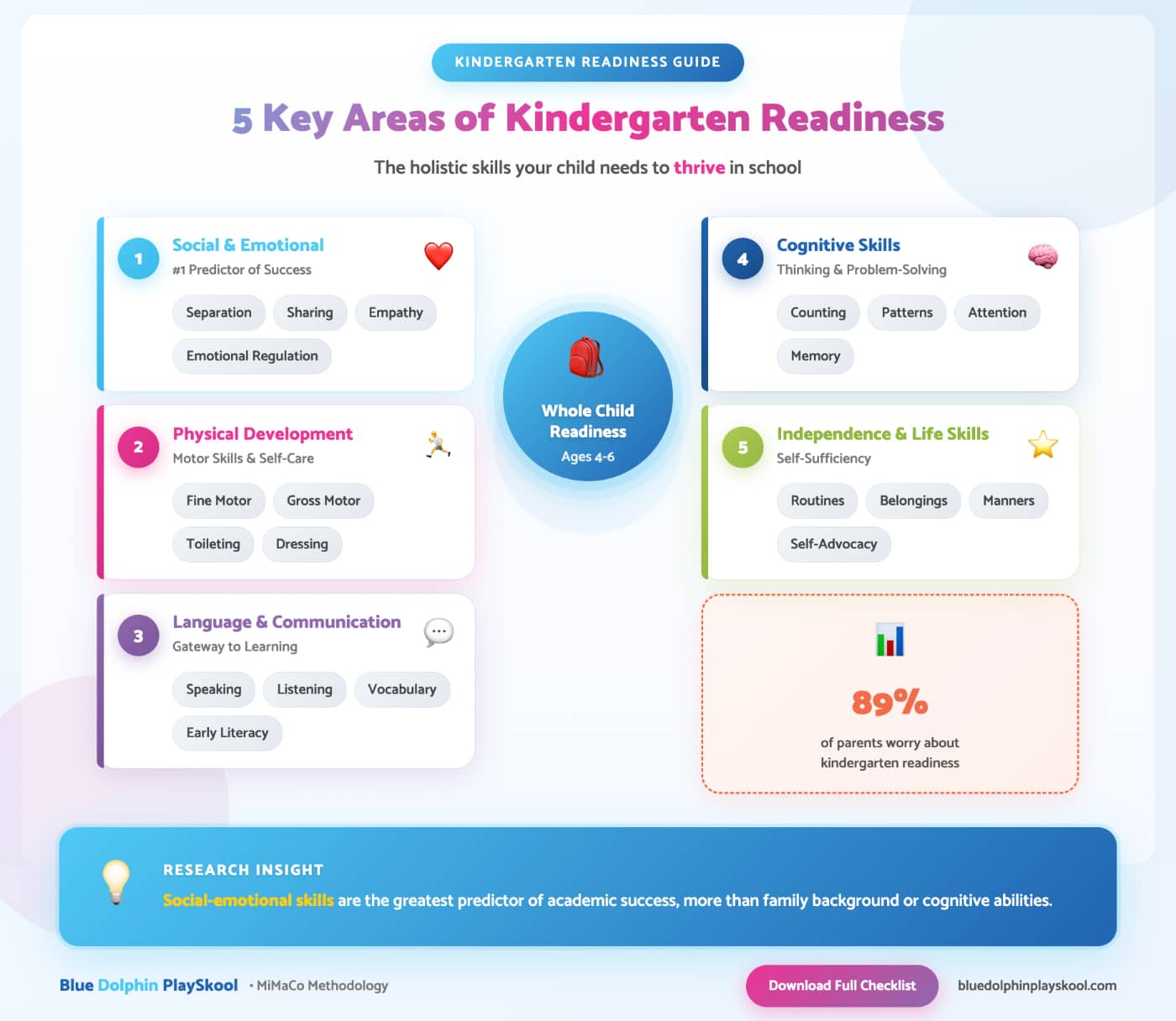
Download the Complete Checklist: Get your free printable Kindergarten Readiness Checklist PDF to track your child’s progress across all five domains. [Download Here]
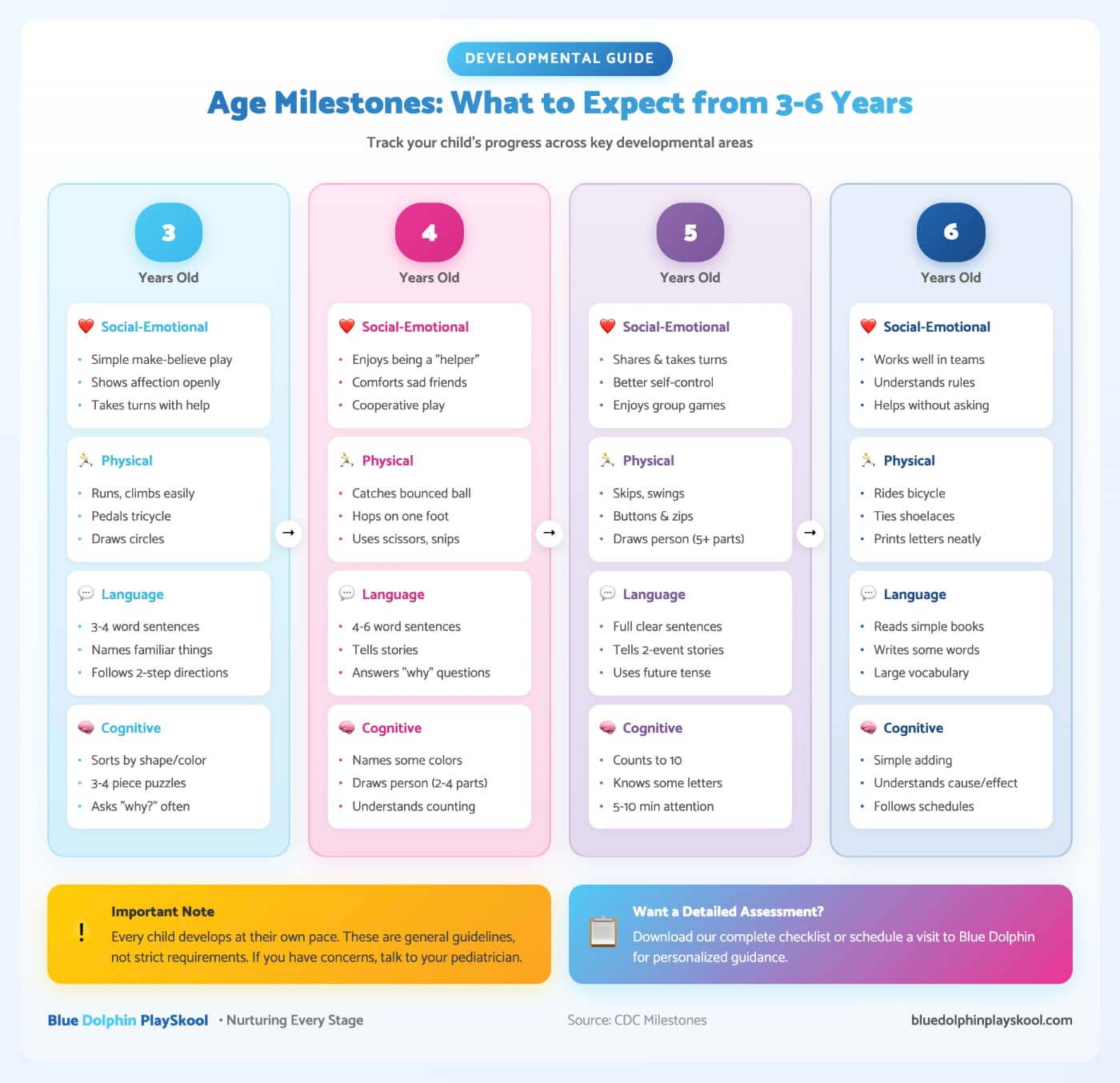
Age-Based Kindergarten Readiness Milestones: What Your Child Should Know
| Age Group | Social-Emotional | Physical & Self-Care | Language & Communication | Cognitive Skills |
|---|---|---|---|---|
| 3-4 Years | Separates from parents with minimal distress (5-10 min); shares toys with prompts; identifies 3-4 basic emotions (happy, sad, mad) | Uses toilet independently with reminders; holds crayon with fist grip; runs without frequent falling; eats with fork/spoon | Speaks in 3-4 word sentences; follows 1-step directions; vocabulary 200-500 words; asks “why” questions | Counts to 5; identifies 2-3 colors; completes 3-5 piece puzzles; sorts objects by one attribute (color OR size) |
| 4-5 Years | Plays cooperatively in small groups; takes turns in games; manages frustration with adult support; follows classroom rules with reminders | Dresses/undresses independently; uses tripod pencil grip; cuts along straight lines; jumps on one foot 2-3 times; washes hands without help | Uses 4-6 word sentences; follows 2-step directions; vocabulary 1,000-1,500 words; retells simple stories; identifies some letters | Counts to 10-15 with one-to-one correspondence; identifies 4-6 colors and basic shapes; creates simple patterns (AB); focuses 5-10 minutes |
| 5-6 Years (Kindergarten Ready) |
Separates confidently; resolves minor conflicts with peers; identifies 5+ emotions; expresses feelings with words; waits turn without grabbing | Fully independent in toileting, dressing, eating; cuts curves and simple shapes; writes recognizable letters/numbers; manages lunch containers alone | Speaks in complete 5+ word sentences; follows 3-step directions; vocabulary 2,000+ words; recognizes own name in print; shows interest in reading | Counts to 20; writes numbers 1-10; identifies all basic shapes; creates and extends patterns; sustains focus 10-15 minutes; demonstrates problem-solving |
Domain 1: Social Emotional Development
Why is social-emotional development the best predictor of success in kindergarten?
Social-emotional skills are THE most critical predictor because they’re a gateway to children being able to learn. “Children need social and emotional skills every bit as much as they do cognitive,” said UNICEF in a statement.
If a child does not have adequate access to an ability to engage with others, and if a child cannot interact appropriately (and manage their insides) then it doesn’t matter how many letters he knows.
Essential Skills Checklist:
Separation & Independence
- Can leave parents without undue distress (brief tears OK, but over 15-20 minutes is concerning)
- Open with transitions into classroom activities (5-10 minutes)
- Exhibits confidence when navigating unknown territory with adult in the vicinity
Peer Interaction & Cooperation
- Shares toys and equipment with prompts
- Rotates during games and activities
- Takes part in activities with a group (circle time, working together toward a common goal)
- Shows interest in making friends
- Shows rudimentary empathy (Comforts upset peer)
Emotional Regulation
- Can Identify 4 to 5 basic emotions (happy, sad, mad, frustrated, excited)
- Express emotions through words rather than physically
- Seeks support from teachers if she gets upset
- Can settle down within 5-15 minutes with the company of an adult
- Handles disappointment without prolonged meltdowns
Following Rules & Routines
- Listens and obeys classroom rules with reminders
- Helps during structured time (circle, snack and clean up)
- Responds well to adult redirection
- Exhibits developing self-control (waits their turn, does not grab)
Insight From an Expert: Sesame Workshop’s ‘Breathe, Think, Do’ Method
- Breathe: Deep breathing can help to relax
- Reflect: What is the issue at hand and what are several potential solutions?
- Do: Try the best solution
This straightforward model is a tremendous teaching tool for emotional regulation, a skill that easily translates into success in the classroom.
Domain 2: Physical Development & Self Care
Why does it matter that children are physically ready for kindergarten?
Motor readiness, and INDEPENDENCE in daily tasks. In kindergarten, we are simply unable to provide the same level of help, in a classroom where ratios are 1:20-25 versus 1:10 for preschool.
After all, when kids can handle the most basic acts of self-care, their cognitive bandwidth is freed up to be 100% in learning.
Fine Motor (Writing and Manipulation):
Hand Strength & Pencil Grip
- Grasps crayon/pencil with thumb and two fingers (tripod grasp)
- Colour in large bodies with dawning management
- Draws identifiable forms (person with 2-4 body parts)
- Copies the basic forms: circle, square, cross
Scissor Skills
- Cuts index cards or construction paper with child-safe scissors
- Oblique lines cutting with higher precision
- Beginning to cut simple shapes
Hand-Eye Coordination
- Threading big beads onto pipe cleaners
- Completes 5-10 piece puzzles
- Combines with blocks and construction toys
- Uses glue sticks, tape with a little assistance
Gross Motor Skills (Movement and Coordination):
Balance & Coordination
- Runs smoothly without frequent tripping
- Jumps on single foot for 2-3 seconds
- Almost always gets the big bouncer
- Stairs: walks up and down stairs with alternating feet
- Pedals a tricycle
Playground Skills
- Climbs playground equipment confidently
- Swings independently on a swing
- Is conscious of space and safety
Self-Care & Independence (NON-NEGOTIABLE):
Toileting
- Goes to the bathroom by themselves (wipes, flushes, washes hands)
- Requests potty breaks if they need them
- Manages clothing (pulling pants up/down)
Dressing
- Wears and takes off coat, shoes, backpack
- Handles simple fasteners (zippers, large buttons, Velcro)
- Tells left shoe from right shoe (sometimes at glance)
Eating
- Use of fork and spoon without too much spill
- Opens up lunch containers, water bottles, snack boxes etc.
- Eats within 20-30 minute period
- Cleans up after eating
Hygiene
- Wash and dry hands with no reminder
- Wipes nose with tissue
- Covers mouth when coughing/sneezing
Domain 3: Language & Communication
How does language growth prepare children for kindergarten?
Communication is key to learning in the classroom. Children have to understand what is said, ask for things and talk with others to be a part of everything that happens in the classroom.
Ohio State University research indicates that children who are read to daily from birth-5 years hear almost 300,000 more words than those not regularly read to. This type of vocabulary exposure is one of the best predictors of success in kindergarten.
Expressive Language (Speaking):
Sentence Structure
- Uses full sentences of 4-6 words
- Uses correct Grammar most of the time (plural, past tense)
- Tells events in order: “First we went to the park. Then I played on the swings. After that we had lunch.”
Vocabulary
- Uses age-appropriate words (1,000 to 2,000 words by age five)
- Common object names, colors, shapes, body parts, relatives
- Uses describing words: heavy/light, hot/cold, happy/unhappy, fast/slow
Conversational Skills
- Banters back and forth for 3-4 turns
- Stays on topic during conversation
- Asks ‘why’, ‘what’, ‘how’, ‘when’ questions
- Responds to simple questions about what has been read, heard or done throughout the day
Receptive Language (Understanding):
Following Directions
- Follows 2 or 3 step directions: “Put on your shoes then, get your bag and line up at the door”
- Translates positional words: over, under, beside, between, top, bottom, in front of, behind
- Understands simple stories and can answer questions about them
Listening Comprehension
- Sits and listens to stories for 5-10 minutes
- Recalls important pieces of information from a story or instructions
- Recognizes characters and plot in well-known stories
Early Literacy Foundations:
Phonological Awareness
- Identifies and creates rhyming words (such as cat-hat-bat)
- Claps syllables in words
- Recognizes the initial sounds of some words
Letter & Print Knowledge
- Recognizes own name in print
- Some letters, own name
- Understands that print carries meaning
- Properly grasps book and turns one page at a time
- Shows interest in books and being read to
Important Note: Children do NOT have to learn how to read before kindergarten. The goal is early literacy foundations, not reading fluency.
Domain 4: Cognitive Skills & Learning Strategies
What cognitive abilities are most predictive of success in kindergarten?
Cognitive readiness isn’t about memorization of facts; it’s about the way children think, problem solve and approach learning. Executive function skills serve as “an air traffic control system in the brain,” Harvard’s Center on the Developing Child says.
These skills, impulse control, planning and flexible thinking, undergird all learning.
Pre-Math Skills:
Number Sense
- Counts to 10-20 (some children may skip digits)
- Rote counts objects to 10 with one-to-one correspondence
- Recognizes written numbers 1-10
- Understands “more” and “less,” “bigger” and “smaller”
- Groups objects by unit (ones, twos, threes)
Shapes & Spatial Awareness
- Identifies and labels basic shapes: circle, square, triangle, rectangle
- Recognizes shapes in a variety of positions and sizes
- Understands positional terms: on, under, beside, between
Patterns
- Identifies simple patterns (AB, ABB, and AAB)
- Continues patterns with items or colours
- Beginning to create own patterns
Problem-Solving & Critical Thinking:
Trial & Error Learning
- Cognitively explores puzzles and problems on his own before seeking assistance
- Attempts many options if it doesn’t work at first
- Demonstrates persistence with challenging activities (tries at least 2-3 times before giving up)
Reasoning & Logic
- Why, how, and simple logic answers
- Predicts: “What will happen next?”
- Sorts and classifies objects by several attributes (color AND size)
Attention & Task Persistence:
Focus & Concentration
- Sustains attention on an activity of interest for 5-10 minutes
- Finishes the tasks appropriate to age (puzzle, drawing or construction project)
- Has some flexibility to focus on other tasks, though often at the cost of a little difficulty and slower focus-switching
Memory
- Recalls daily routines without prompting
- Recalls simple sequences (morning routine, steps in a familiar game)
- Knows songs, chants, or finger plays
Executive Function Skills:
Impulse Control
- Can take turns in games or conversations, wait their turn
- Is in control of himself (doesn’t snatch or hit)
- Follows “stop and think” instructions
Flexible Thinking
- Adjusts to change (deals with change nicely)
- Can move from activities without a huge tantrum
- Accepts different solutions to problems
Domain 5: Independent Living and Life Skills
Why is school readiness equated with independence?
These are the reasons independence is so connected with school readiness: when they’re able to do basic self-care tasks for themselves, children have more of their own cognitive resources to dedicate to learning.
NAEYC research claims that when we teach our little ones to do things for themselves (even if it takes twice as long), a sense of pride, ability and confidence is created.
Classroom Routines & Responsibility:
Following Multi-Step Instructions
- Follows 2-3 part directions: “Put your toys away, wash your hands, and come to the table”
- Recognizes and adheres to morning schedule with pictures/cues
- Transitions between activities when directed
Managing Personal Belongings
- Packs and unpacks own backpack
- Notes coat, shoes, lunchbox
- Puts his or her things away in designated spaces (hooks, cubbies)
- Organizes materials with reminders
Classroom Helper Skills
- Can do some classroom jobs: Line leader, Door holder, Materials helper
- Follows through with reminders on assigned tasks
- Takes pride in completing responsibilities
Self-Advocacy:
Asking for Help
- Uses words to request assistance: “Can you help me with this, please?”
- Requests clarification when he doesn’t understand: “I don’t know what to do”
- Informs teacher of needs: to use the bathroom, feeling sick, thirst, hurts
Problem-Solving Before Asking
- Tries and work on own first (try three before me rule)
- Demonstrates resourcefulness: searches for resources, seeks help from classmates, consults guidelines
Social Etiquette:
Manners & Respect
- Uses “please,” “thank you,” and “excuse me” prompts with reminders
- Waits for his turn to speak (doesn’t cut in)
- Treats adults and peers with respect
- Accepts “no” without extended tantrums
What Can I Do to Help My Child at Home?
Readiness building need not be expensive or entail fancy equipment. Tiny consistent daily routines form the basis for Kindergarten readiness.
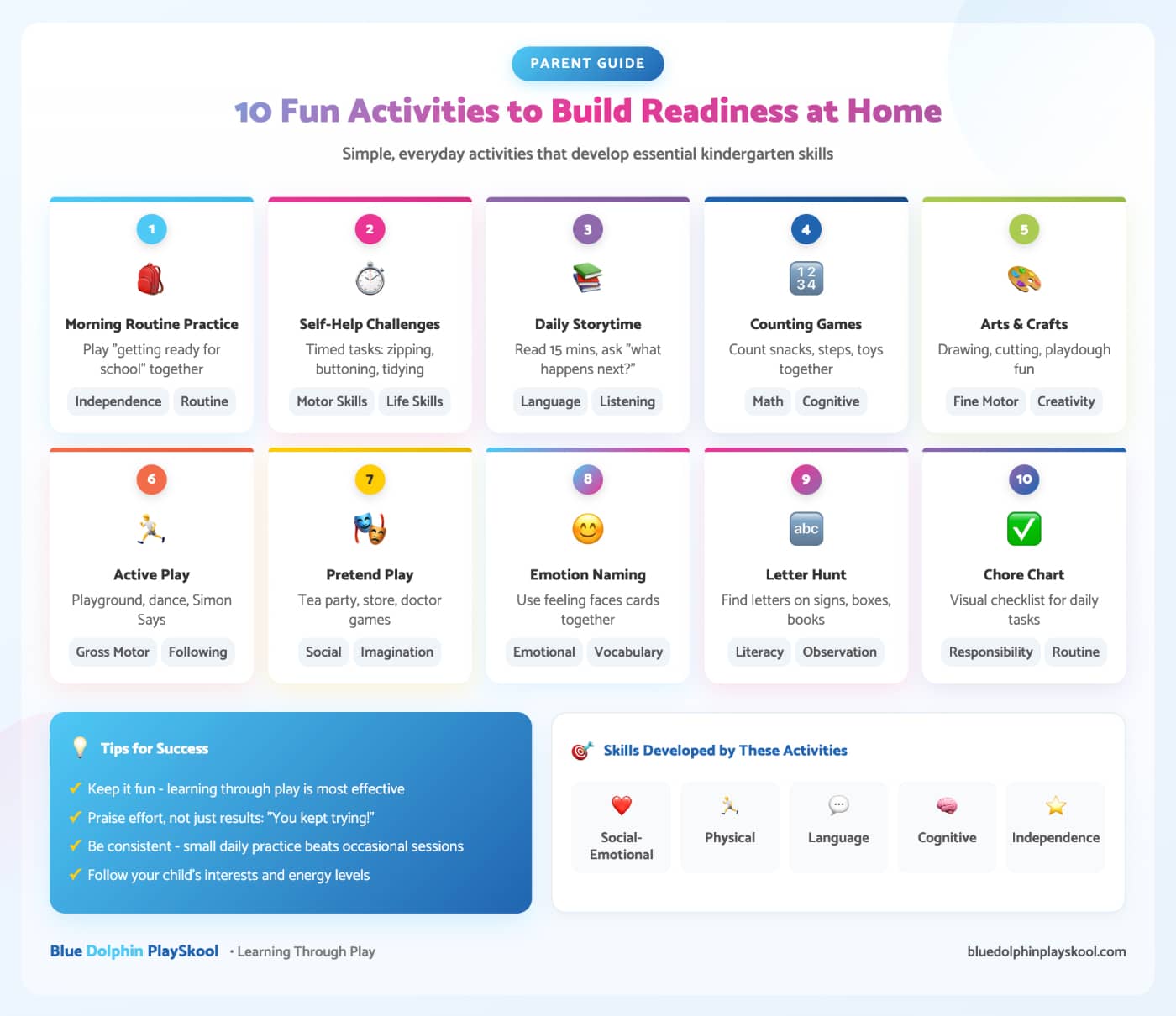
10 High-Impact At-Home Activities:
1. Morning & Bedtime Routine Practice
Skills: Independence, following directions, sequencing, responsibility
How to Do It:
- Draw a visual chart with clipart for each task (ie brush, get dressed, eat breakfast, pack bag)
- Your child may check off or move the images around as each step is completed
- Begin with 2-3 steps and slowly add more
- Start practicing on weekends, when life isn’t as fast-paced at first
- Praise the good stuff: “You remembered to brush your teeth all on your own!”
Blue Dolphin Connection: We focus on providing a set of routines that are easy to predict and follow independently.
2. “Feelings Faces” Emotion Game
Skills Developed: Emotions, self-regulation, empathy
How to Do It:
- Draw or print facial expressions: Happy, sad, angry, frustrated, excited and worried
- Teach via matching: Play “Show me a happy face” or “How do you think he feels?”
- Go about your daily life labeling your emotions, for instance: “I’m so frustrated that I can’t find my keys. I’m going to breathe really deeply.”
- When your child is upset, inform them what the feeling is: “I see you’re really frustrated. Let’s take deep breaths together.”
- Books About Feelings: Read and talk about character emotions
Expert Backing: Studies by Sesame Workshop say children who can pinpoint and manage their emotions are better prepared for classroom conflict.
3. “Simon Says” and listening games
Skills Practiced: Listening, self-control, following multi-step instructions
How to Do It:
- Begin with 1-step commands: “Touch your nose, if Simon says”
- Increase complexity: “Simon says jump on one foot, and then clap three times”
- Teach positional words: “Simon says place the toy UNDER the table”
- Add a bit of silliness with wacky instructions: “Simon says, fly like an elephant”
Variations:
- Treasure hunt with directions 2-3 steps
- Red Light, Green Light for impulse control
- “Mother May I?” for seeking permission and obeying orders
4. Daily Story Time & Interactive Reading
Skills Developed: Language development, foundational literacy, attention span, comprehension
How to Do It:
- Read with them for 15-20 minutes daily (30+ is better)
- Before Reading: “What do you think this book is going to be about?” (prediction)
- During Reading:
- Point to words as you read
- Stop and ask questions: “What do you notice in this picture?”
- Connect to child’s life: “It was kind of like when you went to the park!”
- After Reading:
- Ask questions of understanding: “what came first? Next? Last?”
- Have child retell story in their own words
- Act out the story together
Research Supporting: Children who are read to every day hear 300,000 more words by age 5 than those who aren’t, a gap that can dramatically shape kindergarten success.
5. Counting & Number Games
Skills Practiced: Counting, one to one correspondence, early math concepts
How to Do It:
- Count everything: stairs as you walk up or down, snacks before the meal, toys during clean-up, cars driving by
- Put the table: “We want 4 boards. Can you count as you set them down?”
- Sort games: Sort toys by color, count each group
- Number hunt: Look for numbers around the house (clock, microwave, remote control)
- Snack math: “You have 5 crackers. You eat 2, how many do you have left?”
Keep It Playful: No drilling, no being a spaz. If your child fights you, bail and try again later in a different style.
6. Scissor Skills and Fine Motor Practice
Developed Skills: Hand strength, hand-eye coordination, pencil grip readiness
How to Do It:
- Week 1: Snipping (cutting at any point on a piece of paper)
- Week 2-3: Snipping paper with a straight line drawn on it
- Week 4+: Cut Along Curvy Lines + Simple Shapes
Alternative Activities:
- Playdough (rolling, pinching, squishing, making shapes)
- Tearing paper and making collages
- Sliding bigger beads onto pipe cleaners
- Picking up small things with tongs, tweezers
- Paint with brushes, fingers or cotton swabs
Safety Tip: Never leave scissors unattended. Keep a pair of child-safe scissors with rounded tips handy.
7. Outdoor Active Play
What You’re Building: Gross motor skills, endurance, coordination, making judgments about what’s risky or not
How to Do It:
- Obstacle Course: Crawl under table, jump over pillows, walk on tape line/balance, climb over boxes
- Ball Play: Rolling, bouncing and catching, kicking into target, throwing at target
- Balance Games: Walking on a curb or balance beam, standing on one foot, hopscotch, yoga poses
- Games Running: Tag, Hide and Seek, races, freeze dance
- Playground Time: Bouldering, swinging motion and slide, Exploratory play under careful guidance
Objective: Daily active play for at least 60 minutes (multiple shorter sessions are fine)
8. Lunch Box Independence Practice
Key Skills: Self-care, Fine motor skills, Problem solving
How to Do It:
- 6 WEEKS BEFORE SCHOOL: Practice with real lunch boxes
- Practice opening:
- Snap-lock containers
- Zip-top bags
- Bottled water (try to get the small-opening ones that are easy for the kids to open at school)
- Wrapped items (practice pinch-and-pull technique)
- Time it out: For meals, 20-30 minutes (because kindergartners have short lunch periods)
- Packing practice: Allow your child to assist in packing lunch, pulling from pre-approved selections
- Clean up practice: Trash into the trash can, containers back inside lunchbox
Why This Matters: For 20+ kids, a teacher can’t open lunch containers. Kids who aren’t capable of handling their lunch by themselves often don’t eat enough.
9. Playdates & Social Skills Practice
Skills Learned: Sharing, working together, problem-solving with friends, being a good friend
How to Do It:
- Start with something small: 1 hour playdate with one child at a place he has played often before
- Structure the time:
- Welcome/greeting practice
- Collaborative activity (project, puzzle, construction)
- Physical play (time outside, games that get your body moving)
- Snack time (practice sharing)
- Coach, don’t control:
- Let kids work out small disagreements on their own
- Move in only for safety or long battle parties
- Teach phrases: “May I have a turn?” “You can play when I’m done”
- Debrief afterward: “What was fun? What was hard? How did you work around that issue?”
Ease In: Extend duration of playdates and add additional number of children as your child becomes adjusted.
10. “Quiet Time” Focus Building
Skills Introduced: Attention to task, independence, self-regulation
How to Do It:
- Begin With 5 Minutes: Place a visible timer
- Opt for a quiet activity: coloring, puzzles, viewing books, playdough, building blocks
- Create the environment:
- Quiet space with minimal distractions
- All materials within reach
- You focus on your task (modeling only) nearby
- Increase gradually: Add 2-3 minutes per week until you can stand for 10-15 minutes straight
- Reward success: “You concentrated the entire time! Your attention is becoming so powerful!”
Why This Matters: Kindergartners need to be able to focus on circle time, instruction and independent work. Which also can be learned and polished.
The Blue Dolphin Advantage: MiMaCo Methodology & HEARTS Values
Why Is Blue Dolphin PlaySkool Unique?
At Blue Dolphin PlaySkool, we don’t tick off readiness list boxes, we future proof your child with a revolutionary approach developed for today’s needs of modern global families.
What is MiMaCo?
MiMaCo is short for Mind Management and Comprehensive Approach, our unique learning approach designed to realize each child’s maximum potential referred by:
Mind Management: The instruction of children in how to comprehend and control their own thinking, feelings and behaviors. This actually develops the ability to think about thinking (metacognition) and Theory of Mind, abilities which research shows are vital to kindergarten readiness.
Integrated: Development in all five KBRS domains at the same time, cognitive, social, emotional, physical and behavioral.
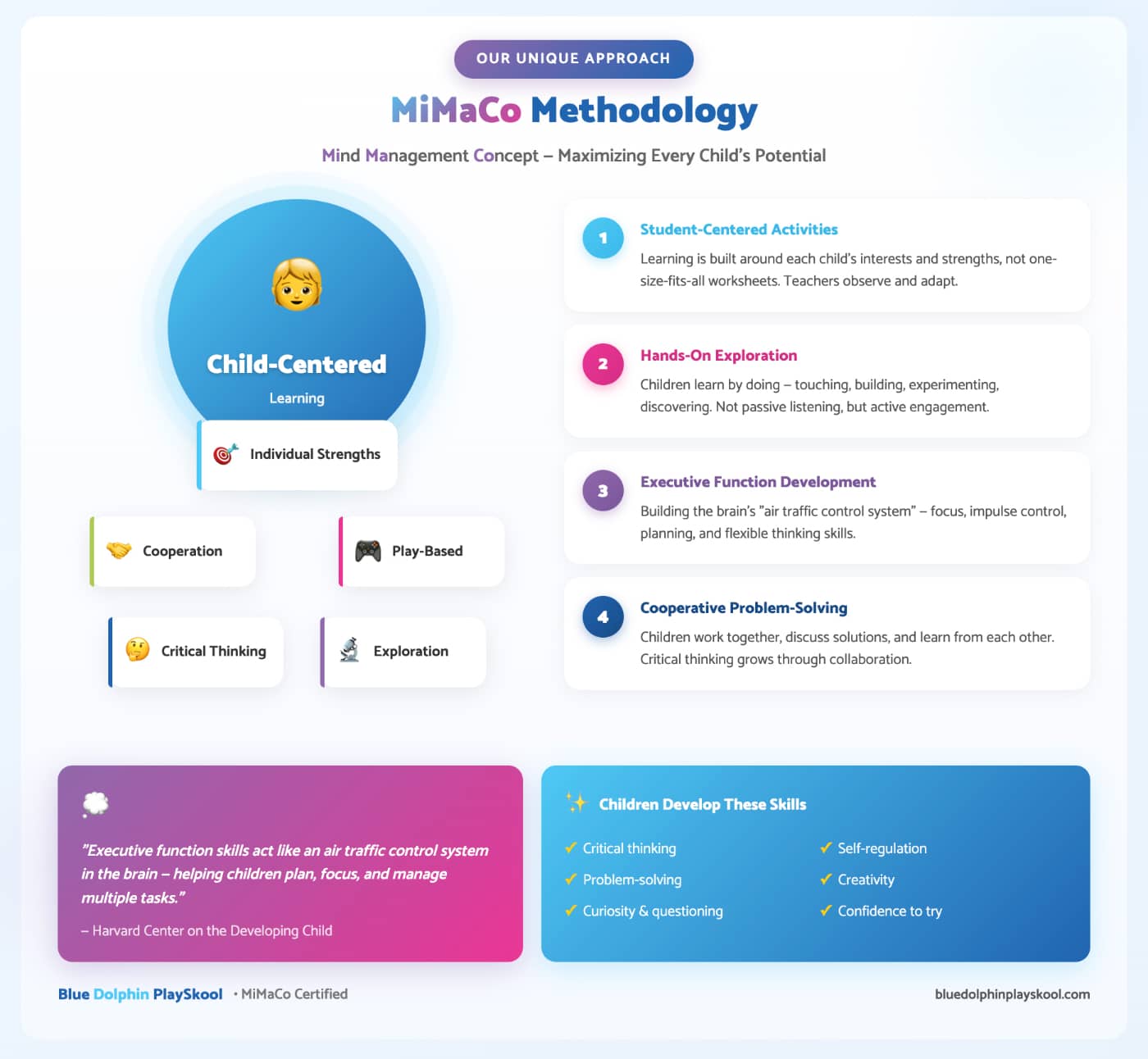
How Does MiMaCo Work in the Real World?
Student-Centered Learning:
- Teachers notice what interests each child, what they are good at, and when they seem to be ready for the next stage of development
- The things to do are being adjusted with the interplay demands
- Children learn to identify what they do and do not know
Play-Based, Purposeful Activities:
- All activities are targeting more than one skill at a time
- Example: Building with blocks develops:
- Fine motor skills (stacking, balancing)
- Cognitive skills (problem-solving, spatial reasoning)
- Pragmatic skills (sharing materials, working together to build)
- Ability to use language (taking turns to explain plans and agree roles)
- Self-regulation (tolerating frustration when tower falls)
Metacognitive Development:
- It’s a lesson in thinking about thinking itself
- Questions like “What’s your plan?” and “How did you come up with that?”
- Building the executive function skills Harvard researchers refer to as “the air traffic control system of the brain”
Research Backing for MiMaCo
Theory of Mind Studies: A child’s theory of mind is the basis for kindergarten readiness because it allows them to:
- Know what they know and don’t know
- Understand what others know
- Acknowledge that teaching is deliberate
- Regulate their own behavior effectively
By promoting internal awareness and self-regulation, MiMaCo teaches the very skills that are better at predicting kindergarten success than IQ.
HEARTS Core Values: The Building Blocks of Social Emotional Excellence
At Blue Dolphin, all interactions are based on our HEARTS values, the foundation for the social-emotional competence proven to be the #1 predictor of kindergarten achievement.
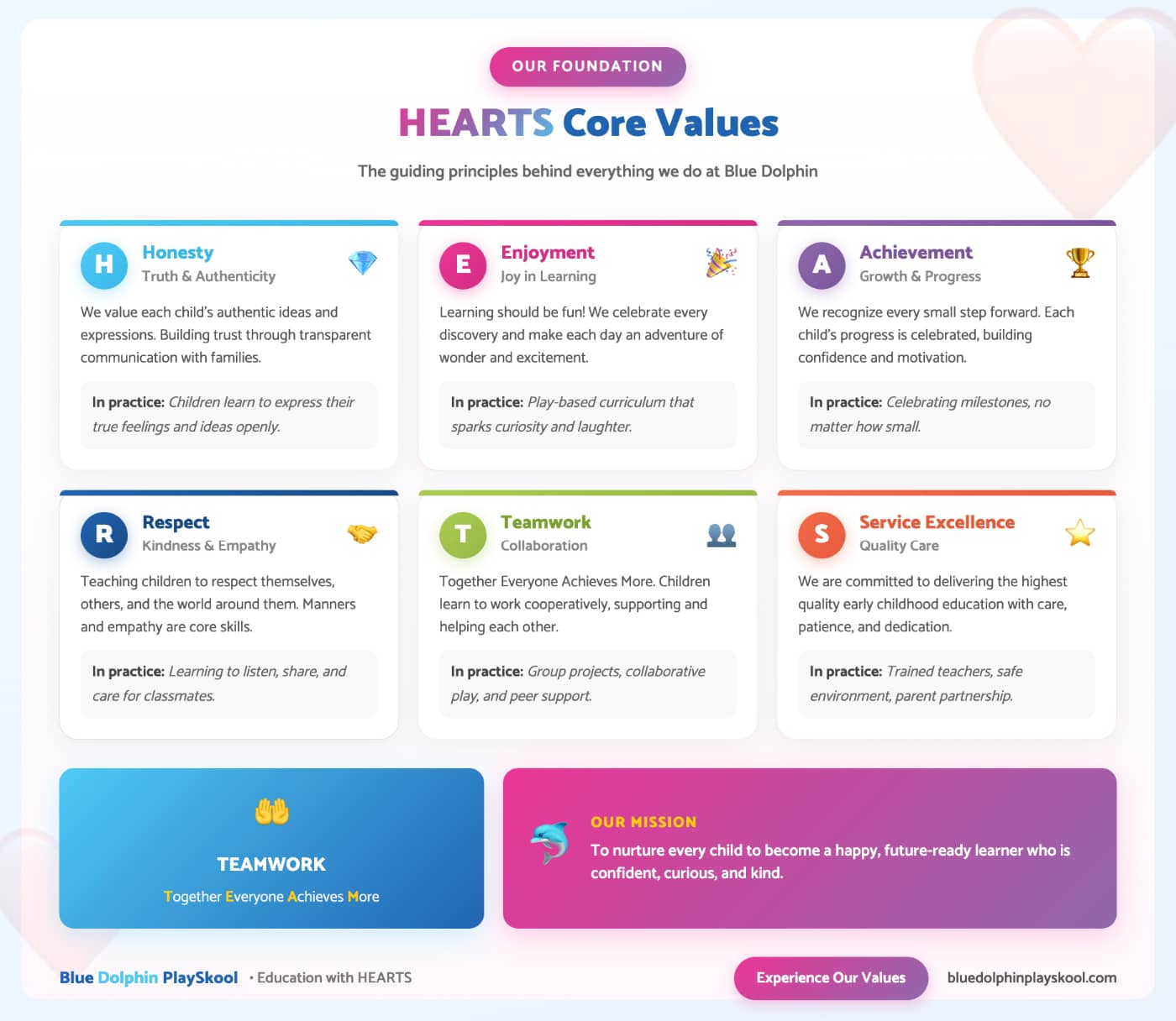
H – HONESTY
- “Trust, honesty, reliability and humanity will emanate from what we do”
- Positive Traits on Display: Honesty, trustworthiness, personal growth
- Kindergarten Readiness: Kids learn to tell the truth about mistakes, which builds trust with teachers
E – ENJOYMENT
- “We like what we do or learn and feel good about ourselves”
- Skills: Love of learning, school connectedness, growth mindset
- Kindergarten Ready: Kids who are excited and curious are more likely to stay hyped, ask questions and adventure
A – ACHIEVEMENT
- “We are obliged to the ideal development of every child”
- How We Did It: Goal setting, sticking to it and the satisfaction of a job well done
- Ready for Kindergarten: Children think they can learn new things through effort
R – RESPECT
- “Everyone should be treated with respect at all times”
- Life Skills: Empathy, consideration, cultural awareness, manners
- Kindergarten Readiness: Children understand how to respectfully interact with peers, teachers and materials
T – TEAMWORK
- “We collaborate, we take care of each other, we help one another”
- Skills: working together, assisting others, seeking help, mutual goals
- Who Makes The Best Kindergarten: Children can work in groups and soak up the camaraderie
S – SERVICE EXCELLENCE
- “We promise the best service for you to succeed!”
- Lessons: Standards, quality of work, attention to detail
- Exciting Start of Something New: That they’ve got to give it their all because their best is good enough
Program Options Designed for Readiness
PlaySkool (18 months – 6 years)
Our signature preschool and kindergaten program which incorporates the MiMaCo approach in every aspect. Through purposeful play, children engage in rich learning experiences and develop all five readiness skills.
Play & Learn
Our rigorous, yet fun and engaging paid kindergarten readiness program. Great for children in the year before they enter school.
PlayNest (18 mths to 3 years)
A full childcare for working parents, enrichment which aims to cultivate a love of learning, stimulate curiosity and help the child develop skills and habits in order to be set in an environment that is safe & enjoyable.
PlayHouse (Full Day Programme)
Fuses formal education with after-school care, learning new skills and talents, coupled with instil good habits, proper etiquette and social mannerism.
International Curriculum Partnerships
Jolly Phonics – Synthetic phonics lesson featuring multi-sensory methods (story-telling, songs, images, actions) for learning letter sounds and early reading
National Geographic Kids – Science exploration through hands-on activities and the discovery of digital learning tools that are engaging
Origo Math – Online learning platform that combines hands on and digital resources to develop mathematical thinking
Littlelives System – Auto sync of attendance, daily updates and real-time parent communication for effortless school-home link up
Success Stories: Parent Testimonial
“I am so thankful that we have made this choice of sending our children to Blue Dolphin PlaySkool. It is a clean and comfy school with balanced outdoor play and classroom learning activities, field trips, art and music in the curriculum. A lot of development in personality and communication skills that we see. With the help, attention, patience and great observation of their teachers they also become more independent in their everyday tasks. The time that they are in the Blue Dolphin studying will be good for them to study in the future.”
— Mr. Arif Tri Waluyo & Mrs. Erika Anggraeni, The Parents of Louis
Special Considerations for International Families
What Are the Special Challenges of International Families?
International families & expat kids, When the time comes to get your international-born children ready for kindergarten it can appear rather overwhelming. This part covers bilingualism, the cultural adjustments in bridging local Indonesian expectations and international school demands.
What is the Impact of Bilingualism on Kindergarten Readiness?
The Research-Backed Benefits:
Bilingual and multilingual minds are:
- Quicker and more flexible in problem solving
- More organised, can manage their impulses and are better close-attention
- Enhanced in memory capabilities
- More cognitively flexible
- Better at discarding irrelevant information
Development Timeline:
- Younger kids adapt to bilingual families more readily
- Children usually dominate in one language at first, its perfectly common
- Passive use (comprehension) comes before active use (speaking)
- The most efficient way to learn natural language is through immersion and play
What Parents Should Know:
- Children are not “confused” by simultaneous bilingualism, it’s how their brains were made
- It is thus natural that children routinely hear both languages used together and code-switch (mix languages) as part of the normal statement
- Children may be silent in their second language for a time when coming to bilingual programs, and that’s okay
- Both contribute to an explosion of expressive language
Supporting Bilingual Development:
- Keep first language strong at home (framework for all languages)
- Read in both languages daily
- No need to worry about “mixing”, bilingual children are really good at learning how to keep their languages apart
- Appreciate one another’s cultures, and remember, language is linked to identity
- Be patient, bilingual children may have slightly smaller vocabulary in each language, but between the two languages they are as good or better than monolinguals
Who is the TCK and What Are The Implications for Readiness?
What is a Third Culture Kid?
TCKs (or Third Culture Kids) are those who grow up with a cultural identity that is different from their parents’ native culture. They form bonds across a variety of cultures without being owned fully by any one culture.
Unique Challenges:
- Several moves across countries/schools/friends
- Identity questions, “Where do I come from?”
- Grueling and heartbreaking, goodbye to friends, houses, surroundings
- Adjustment periods in new locations
- Managing homesickness for previous locations
Specific Readiness Concerns for TCKs:
Separation Anxiety & Homesickness:
- May miss former site, not parents’ homeland
- May present with difficulty transitioning to a new classroom
- May grieve the loss of friendships
Parental Strategy:
- Keep family communication open around feelings and transitions
- Help the child to call or write old friends on a regular basis
- Create memory books from previous locations
- Let’s acknowledge and validate feelings, too: “I understand it is hard for you to miss our friends from Singapore”
- Routines should be established in new location immediately
Making New Friends:
- TCKs require explicit instruction in friendship-building tools:
- Inviting peers to play
- Eating with different kids at lunch
- Offering toys to make other people feel at home
- Foster cultural exchange: “Could you teach your new friend a word in another language?”
Building Global Resilience:
When family identity and communication are strong, TCKs assets have an opportunity to shine:
- Social acumen, can adapt to varying cultural norms
- Linguistic capability, fluent in more than 1 language
- Perspective taking across the globe, understanding diversity
- Immunity, to being changed, that is
- Empathy, knowing what it’s like to be ‘new’
Are Indonesian TKs As Good As International Schools?
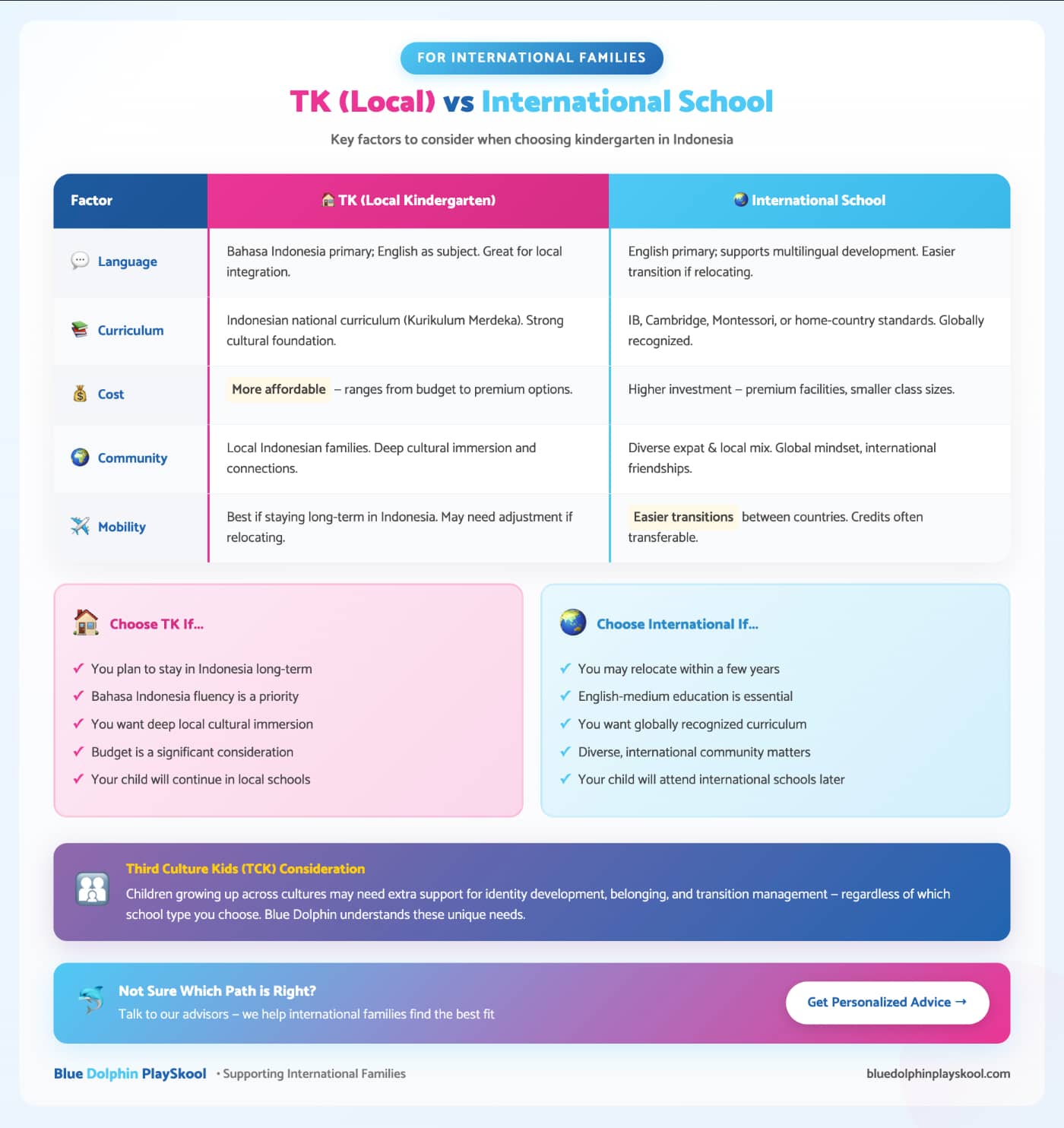
Understanding Your Options:
Local TK (Taman Kanak-kanak):
- Ages 4-5 (TK A) and 5-6 (TK B)
- Merdeka (Independent) Kuruikulum, It is student-centred, agile and responsive to cultural needs
- Six Developmental Areas: Religious/Moral Values, Physical-Motor, Cognitive, Language, Social-Emotional and Arts
- Instruction primarily in Bahasa Indonesia
- Educating through play (Bermain sambil Belajar)
- Way cheaper (often free if public)
- Rapid assimilation and sounds like a local
International Schools:
- Adopt foreign curriculum (American, British, IB, Canadian, French)
- Medium of instruction in English (or other school’s specified language)
- Cost (usually over $10,000 per child each year)
- Small classes, native English speaking teachers
- More ease of transfer while emigrating, Transferable with more ease to another place gained by immigration
- IB (International Baccalaureate) is very well regarded internationally
Blue Dolphin’s Position:
As an international preschool, Blue Dolphin prepares kids for both:
- MiMaCo approach fosters generic competences necessary in any learning area
- English to prepare children for international schools
- The holistic approach prepares for TK and international kindergarten
- Acknowledging and respecting Indonesian context
Decision Factors for International Families
Choose Local TK if:
- We’re planning to be in Indonesia for the long-haul (3+ years)
- Desire for deeper cultural immersion and fluency in Bahasa Indonesia
- Value this integration into local culture
- Budget is primary consideration
- Child is young (older/bigger kids will generally have an easier time adjusting to this change)
Choose International School if:
- Short-term assignment (1-2 years)
- Have plans to go home or move again
- Want curriculum continuity across moves
- Child is special needs and requires special support
- English language maintenance is priority
Choose Blue Dolphin PlaySkool for:
- International standard with Indonesian context
- Preparation for the local or int’l primary school
- Multicultural environment that celebrates diversity
- teach in English with saving Indonesian culture
- Development of entire students toward their international readiness
Minimum Standards Of Services ECE in Indonesia
The Indonesian Mata Ajar Serve (MSS) were set up by the government as minimum service standards for quality ECE:
- 5-6 years, at least 1 year of preprimary (ECE) before start of primary school
- The holistic development (behavioural, cognitive emotional, social) should be given attention
- Play-based learning approach
- Constructivist pedagogics, children as discovering and exploring learners
- Adaptation to local cultural values
Blue Dolphin Compliance: Our courses meet and combine Indonesian MCS whereas support international standards, graduates are ready for choice of further education.
Frequently Asked Questions
What skills when my child know before kindergarten?
Imagine readiness as the wrapping around the “whole child.” Basic skills: following basic rules, taking turns, sharing with peers, expressing needs in words and managing big feelings. In temper all that is expected of children for a 2 year old, physically they should already be able to hold a pencil/crayon, run and jump (Walk or Jump with both feet together), take care of their toileting needs or clothing. Linguistically, they should be speaking in simple sentences (4-6 words) and responding to basic commands. Early math and cognitive skills, such as being able to count up to 10 or recognize some letters, would be a bonus. Bedrock independence is also key: Can your child wash hands, pull on shoes and feed herself?
How do I know if my child is ready for kindergarten?
Look at daily behavior. Is your child typically good at playing with other children and trying new things? Do they comply with basic routines, say, clean-up time, after some reminding? Do they express themselves and do they understand orders or questions? Refer to the list when you have something in mind. If you see hot spots of concern (such as extreme separation anxiety or not speaking at all), talk to a pediatrician or a preschool teacher. Frequently readiness can be enhanced reasonably quickly with a little bit of practice and support.
Is it important for my child to read before kindergarten?
No. Your child does NOT have to be reading before they start kindergarten. What your child does not need: A narrow set of “pre-reading” skills, Teaching that is more aimed at cramming knowledge than avid learning. What’s best for young readers is likely what’s best for all learners, to feel curious, connected and capable. Kindergarten readiness is not reading fluency but understanding these early literacy basics!
My child is shy. Will they struggle in kindergarten?
We’re not shy, shyness is a temperamental trait, not a preparation problem. Shy children often do just fine in kindergarten! What’s important is if your shy child can: Separate from you (even if it takes a few extra minutes to warm up), Engage with activities once settled, Ask teachers for what he needs when he isn’t getting the help he wants and needs, or when something has upset him, Form at least one or two connections with peers. Support strategies could include: Role-playing social situations in short bursts, Acknowledging their feelings- “It’s natural to feel a little bit shy”, Avoid labeling as ‘shy’ to his/her face, Organizing small playdates (1-2 children max) at your house or theirs, If you have it be possible, visit the kindergarten classroom prior to the first day. Plenty of reticent kids come out of their shell in the structured, supportive school environment of a good kindergarten program, such as Blue Dolphin.
What if my child is bilingual/ multilingual?
This is a feature not bug. Some benefits of bilingualism in children include: Improved cognitive flexibility, Higher-level problem-solving skills, Superior executive function, Greater cross-cultural competence. Here are some great points: Bilingual toddlers and children may have slightly smaller vocabularies in each language (but across both languages, their total vocabulary is often equal to or greater than that of monolingual children). They might go through a “silent period” when learning a second language, this is normal. Code-switching (mixing languages) is part of typical bilingual development. Both languages help with cognitive development. At Blue Dolphin: We appreciate multilingualism and are dedicated to working with children in their home language, because the development of a strong first language is central to acquiring additional languages.
How can I know if my child should be screened?
When to Seek Professional Evaluation:
- Your child is not meeting any of the aforementioned milestones in multiple developmental domains
- You see regression (change from previously mastered abilities) occurring several months following a parent’s notice of change in development or skills
- Child is showing little or no change over a three-month to six-month period even with interventions in the home setting to support at age-appropriate opportunities for acquiring new skills
- Consistently is experiencing severe emotional distress when other children his/her age are not, and has been happening for some time
- instinct tells you something needs attention
Usual screening opportunities: Well-child runs of pediatric visits (18 mo, 2y, 3y, 4y, 5y), During preschool developmental assessments, Early Intervention programs (usually birth-3), school district screenings usually before kindergarten.
Key message: Searching out a screening is a show of being an informed parent who is proactive, not that you’ve failed. When caught early, kids can thrive.
Your Child’s Journey to Kindergarten Success
The Key Takeaways
Kindergarten readiness is more about all of your child, not just what he learns. The five essential domains are:
- Social-Emotional Skills (the #1 Predictor of Success)
- Physical Development & Self-Care
- Language & Communication
- Cognitive Skills & Learning Approaches
- Independence & Life Skills
Every child grows in his own time. A lot of variation is normal and to be expected. The aim is steady progress, not perfection.
Little everyday activities that you incorporate into your daily routine are building blocks for kindergarten. You don’t need fancy programs, you need intentionality and consistency.
The post-pandemic world is one that will require many children to heal with more support than others, but our brains are resilient. With focused activities and early intervention if necessary, children can catch up.
Social-emotional development and independence are MORE important than academics. A child who can control impulses, understand emotions, follow directions and feed or dress themselves will succeed in kindergarten even if they still don’t know all their letters.
What You Can Do Now
This Week:
- Read to them 15-20 minutes a day
- Practice an emotion-coaching conversation once: “I can see you’re upset. Let’s take deep breaths”
- Have child do one self-help task: get dressed, pack their bag for school, and open their lunch
This Month:
- Make a visual schedule for morning or bedtime
- Set up a playdate, working on taking turns and sharing
- Get used to opening up all the lunch containers and packages
- Have your child finish one task for you around the house
Over the Next 3-6 Months:
- Gradually increase up to reading for more than 30 minutes every day
- Extend their alone time to 10-15 minutes
- Get practice following 2-3 step instructions with routines at home
- Establish a regular bedtime and wake-up routine
- Active outdoor play for more than 60 minutes per day
- Only 1 hour/day of screen time and no more
When You Need Help From Pros
Blue Dolphin PlaySkool Provides a complete kinder ready program to prepare your child for school made up of:
MiMaCo (Feelings Factory) – Learning to self-regulate and use our brain (executive function) holistically across all 5 Readiness Domains
HEARTS Values – Constructing the social-emotional competency that informs long-term success
International Standards – Have children ready for local TK and international schooling paths
Trained Teachers – Prepared to identify and help each child reach his or her potential
Proven track record – 495+ families in yogyakarta, 100+ graduates in bali, a steady option for kids getting them direct offers to our selective schools
Your Next Steps
1. Download Your Free Kindergarten Readiness Checklist
Download our inclusive, printable checklist that covers all five domains and the milestones relevant to each age. And use it to monitor your child’s progress and see what you might want to concentrate on.
2. Schedule a Campus Tour
Watch the Mimaco process and heart values in action. Come and meet our teachers, take a tour of the classrooms and ask whatever questions you may have.
Contact Blue Dolphin PlaySkool:
- Phone: +62 812-1697-8883 (Indonesia)
- Website: www.bluedolphinplayskool.com
- Branches: Surabaya | Yogyakarta | Bali Kuta | Bali Puri Gading
3. Begin Your Home Readiness Activities
Begin with just 2-3 activities from this post. Small, deliberate steps power big results. Remember, you are your child’s first and most important teacher.
Final Words of Encouragement
Kindergarten readiness can be daunting, but here’s a truth: If you’re reading this guide, you are doing the right thing. You’re smart, you’re considerate and you care about the success of your child.
Most children are more prepared than you think they are. By encouraging daily practice of activities, routine support, and by celebrating small successes you can ensure your child is ready to soar when they walk into kindergarten on day one.
And remember, kindergarten is just the start. The skills that you are teaching now, ability to regulate emotions, independence, interest and curiosity, resilience and love of learning, will serve your child forever.
Your child’s journey is unique. Trust the process. Celebrate the progress. Enjoy this precious time.