Introduction: Why This Decision Matters
Is your child ready for their first big educational step? With over 100 preschool options across Indonesia’s major cities, finding the perfect fit can feel overwhelming. Yet this decision carries profound implications: research consistently shows that 90% of brain development occurs before age five, and more than one million neural connections form every second during the first few years of life.
The right preschool environment today builds the foundation for your child’s academic success, emotional resilience, and social confidence for years to come. According to Nobel Prize-winning economist James Heckman, high-quality birth-to-five early childhood education delivers a 13% annual return on investment through better outcomes in education, health, employment, and social behavior.
This comprehensive guide is designed to cut through the noise. We’ll walk you through everything you need to know, from understanding Indonesia’s preschool landscape to the specific questions you must ask during school visits, so you can make a confident, informed decision for your family.
Understanding Preschool Education in Indonesia
Preschool vs. Kindergarten: What’s the Difference?
In Indonesia, early childhood education (PAUD – Pendidikan Anak Usia Dini) encompasses both formal and non-formal programs with distinct developmental purposes:
- Playgroup (KB – Kelompok Bermain): Typically serves children aged 2 to 4 years. The focus is primarily on socialization, sensory play, motor skill development, and gentle separation from parents through supervised play activities.
- Kindergarten (TK – Taman Kanak-Kanak): For children aged 4 to 6 years (divided into TK-A for ages 4-5 and TK-B for ages 5-6). This stage shifts toward more intentional preparation for formal schooling, incorporating structured activities focusing on early literacy, numeracy, and cognitive development while maintaining play as an integral component.
Many preschools in Indonesia, including Blue Dolphin PlaySkool as one of the best preschool options, offer continuous programs spanning from 18 months to 6 years, allowing families to benefit from a consistent educational approach as their child grows through age-appropriate classes.
The Science-Backed ROI of Early Education
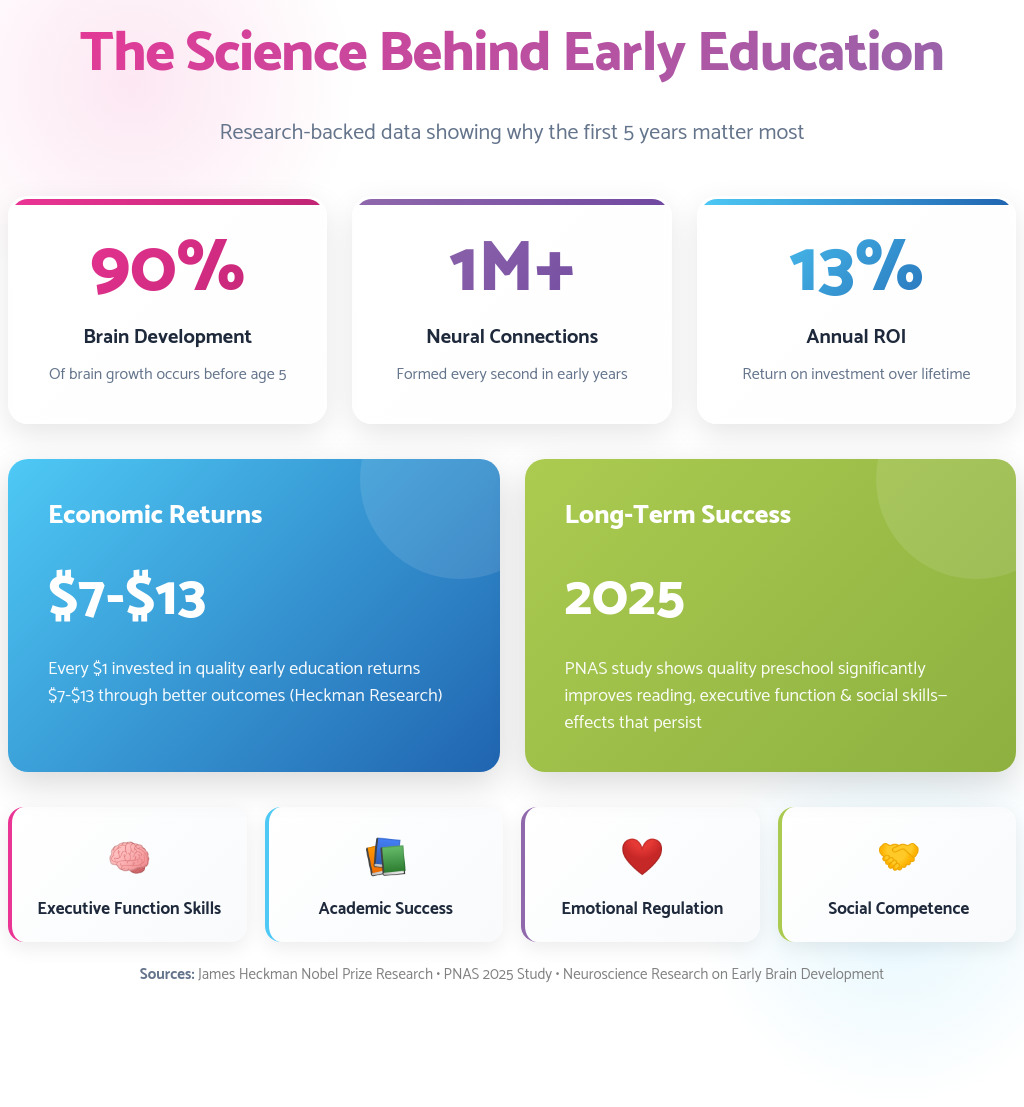
The benefits of quality early childhood education extend far beyond basic childcare. Current neuroscience research confirms that children’s brains develop at an extraordinary pace during the first five years, the brain reaches approximately 90% of its adult size by age five, with neural connections forming at a rate never replicated again in life.
Key research findings supporting early education investment include:
- Executive Function Development: High-quality early education supports the formation of neural connections that drive executive function skills, focus, planning, self-regulation, and multitasking, which predict long-term academic and life success.
- Economic Returns: Professor Heckman’s comprehensive research demonstrates that every $1 invested in high-quality early childhood education yields returns of $7 to $13 over the child’s lifetime through improved education outcomes, better health, higher employment rates, and reduced social costs.
- Social-Emotional Advantage: Children who attend quality preschools develop stronger vocabulary, better emotional regulation skills, and enhanced social competencies compared to peers without early education experiences.
- Long-Term Academic Success: A landmark 2025 PNAS study found that children in quality preschool programs demonstrated significantly better reading scores, executive function, short-term memory, and social understanding by the end of kindergarten, with effects that persisted rather than fading.
The 10 Essential Factors to Evaluate
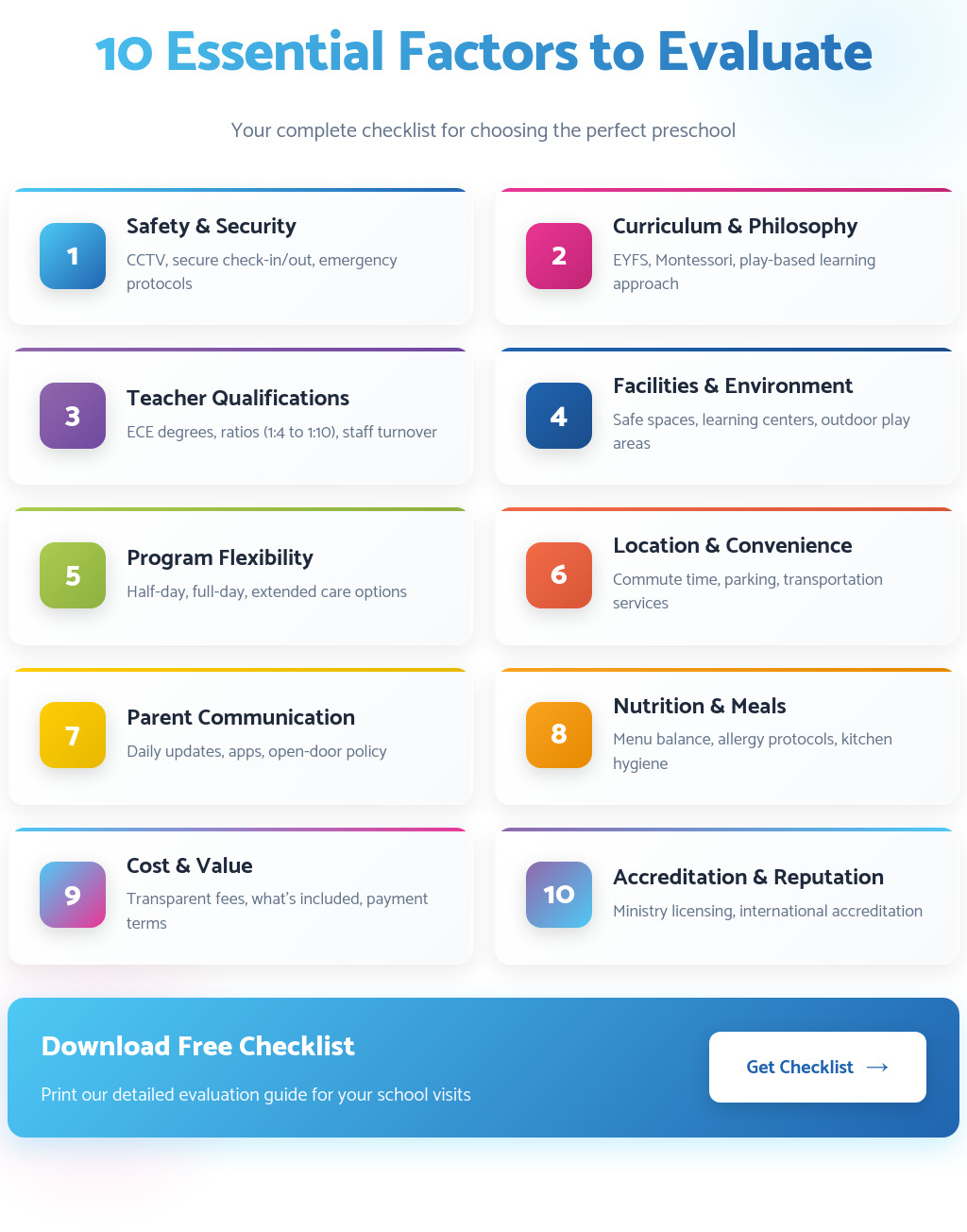
When visiting or researching schools, use this comprehensive framework to ensure you’re making a well-informed decision. Each factor can significantly impact your child’s experience and your peace of mind.
1. Safety & Security (The Non-Negotiable Foundation)
Your child’s safety, both physical and emotional, is paramount. Evaluate CCTV coverage in classrooms and common areas, secure check-in/check-out procedures with ID verification, staff training in pediatric first aid and CPR, emergency protocols for fire, medical situations, and natural disasters, and hygiene standards including toy sanitization and handwashing routines. Equally important is emotional safety: children should feel comfortable and secure, with staff responding to distress calmly and positively.
2. Curriculum & Teaching Philosophy
A strong curriculum balances academics with soft skills development. Look for recognized frameworks like the UK’s Early Years Foundation Stage (EYFS), which covers seven learning areas through play-based exploration, or established methodologies like Montessori. The curriculum should nurture cognitive, social, emotional, and physical development, not just rote memorization. Ask to see daily schedules and weekly lesson themes to understand how learning time is structured.
3. Teacher Qualifications & Ratios
Teachers are the heart of any preschool. Verify that lead teachers hold degrees or certifications in Early Childhood Education and participate in continuous professional development.
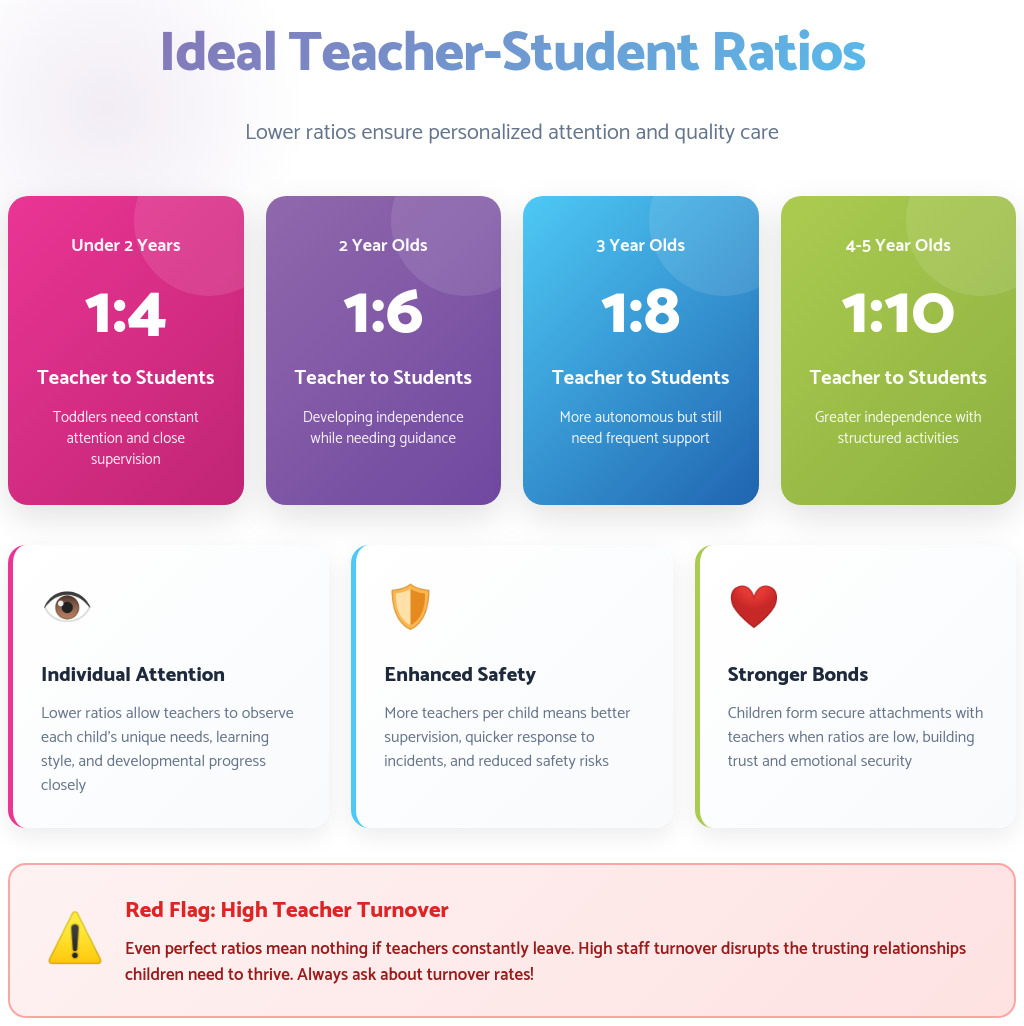
Equally critical is the teacher-student ratio: ideal ratios are approximately 1:4 for toddlers (under 2 years), 1:6 for 2-year-olds, 1:8 for 3-year-olds, and 1:10 for 4-5-year-olds. Low ratios ensure personalized attention. Also inquire about staff turnover, high turnover disrupts the trusting relationships children need to thrive.
4. Facilities & Learning Environment
The physical environment should be stimulating yet safe. Indoor classrooms need age-appropriate furniture, open-ended learning materials (blocks, art supplies, role-play sets), and distinct learning centers. Outdoor spaces should include safe play equipment with proper surfacing. Check for rounded furniture corners, finger guards on doors, adequate lighting, and proper ventilation. A clean, well-maintained facility with organized spaces encourages focused exploration and learning.
5. Program Options & Flexibility
Modern families have diverse scheduling needs. Evaluate whether the school offers half-day programs (typically 7:45 AM – 11:30 AM), full-day programs (extending to 3:00-3:30 PM), extended care or after-school options for working parents, and flexible attendance options (3-day or 5-day programs). Some schools also offer seasonal holiday camps, valuable for working parents needing year-round care solutions.
6. Location & Convenience
In Indonesia’s traffic conditions, proximity matters significantly. A commute longer than 30 minutes can fatigue young children and complicate daily routines. Consider distance from home and work, drop-off and pick-up safety and accessibility, parking availability, and whether transportation services are offered. Schools with multiple campus locations provide flexibility for families living or working in different areas.
7. Parent Communication
Quality preschools maintain strong home-school partnerships. Look for daily or weekly progress updates through apps or messaging platforms, regular parent-teacher conferences, digital portfolios documenting your child’s development, an open-door policy welcoming parent visits and observations, and responsive communication channels for addressing concerns. Technology platforms like Littlelives enable real-time attendance tracking and teacher-parent messaging for seamless communication.
8. Nutrition & Meals
Nutrition directly impacts learning, energy levels, and health. If meals are provided, request sample menus to assess nutritional balance and variety. Verify allergy management protocols, kitchen cleanliness, and whether the school promotes healthy eating habits. Ask how they handle special dietary requirements and whether children are taught self-feeding skills appropriate to their age.
9. Cost & Value
Understand all fees before committing. Request a complete breakdown including registration and development fees, tuition (monthly or term-based), what’s included (meals, materials, uniforms, activities), additional costs for field trips, seasonal camps, or enrichment programs, and late pick-up policies. The most expensive school isn’t necessarily the best, evaluate value based on facilities, teacher ratios, program quality, and outcomes rather than price alone.
10. Accreditation & Reputation
Verify the school’s credentials and community standing. Check for official licensing from Indonesia’s Ministry of Education (Kemendikbud), international accreditations if applicable (IB, Cambridge, or recognized ECE bodies), and community reputation through reviews and parent testimonials. Reputable schools proudly display their certifications and welcome inquiries about their credentials.
Understanding Different Preschool Approaches
Preschools follow various educational philosophies. Understanding these approaches helps you find the right “fit” for your child’s temperament and your family’s values.
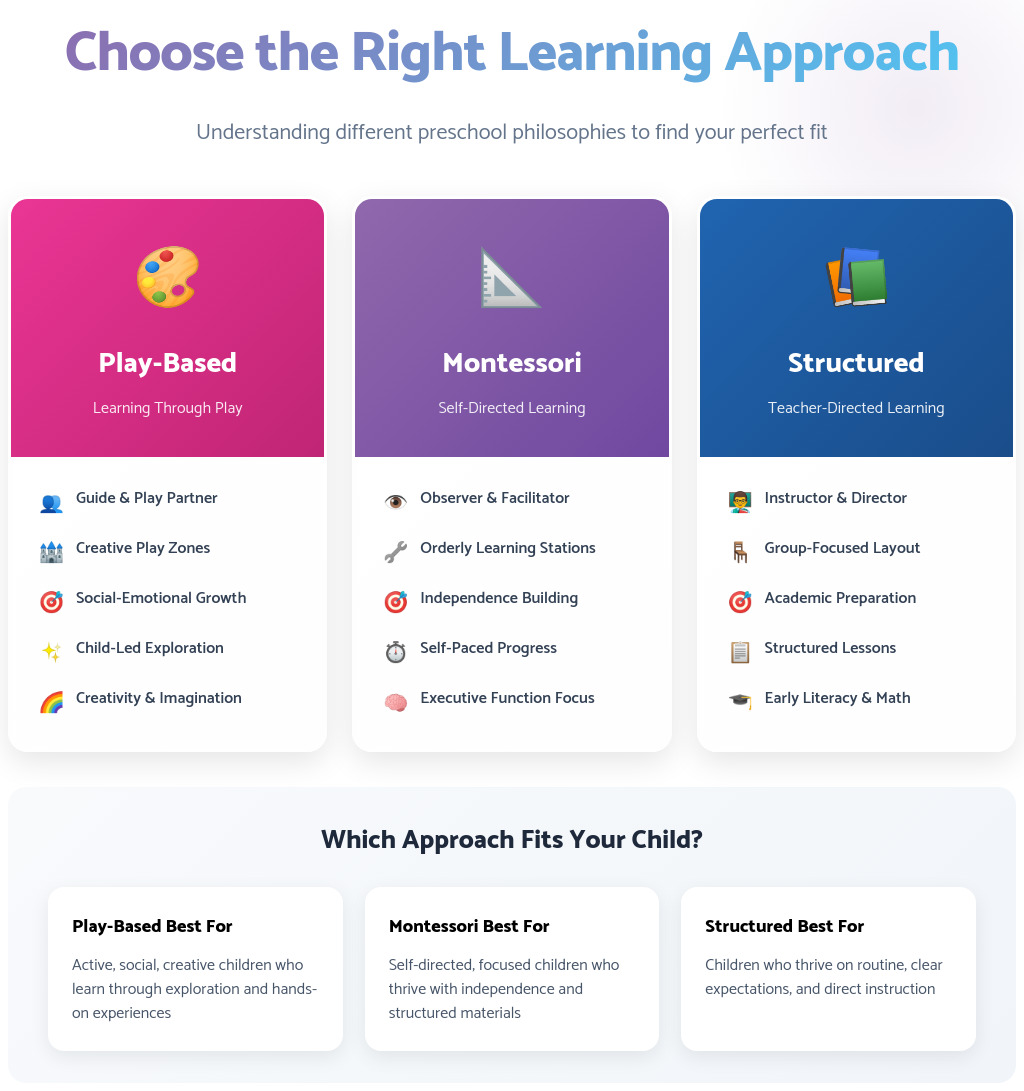
Play-Based Learning
In play-based environments, children learn through open-ended play, games, storytelling, and social interaction. The curriculum is often “emergent,” evolving based on children’s interests. Teachers act as facilitators, setting up engaging activities and guiding learning through play. Research confirms that play-based learning builds creativity, social skills, and a genuine love for learning, skills that predict long-term academic success.
Montessori Method
Montessori classrooms feature child-led, self-paced learning using specially designed materials. Teachers serve as guides and observers, presenting materials then allowing children to work independently. Mixed-age groupings (typically 3-year spans) enable peer learning and mentorship. A landmark 2025 national study published in PNAS found that public Montessori preschool students demonstrated significantly higher scores in reading, executive function, short-term memory, and social understanding compared to traditional programs, while costing approximately $13,000 less per child.
Structured Academic Approach
Teacher-directed programs emphasize structured lessons in early literacy, numeracy, and school readiness skills. Class time includes circle time, guided activities, and sometimes workbooks or worksheets. This approach can benefit children who thrive on routine and explicit instruction, though experts caution against overly rigid programs that may stifle creativity in very young children.
Blended/Holistic Approaches
Many quality preschools blend elements from multiple approaches, combining structured learning periods with free play, incorporating Montessori materials within guided curricula, or integrating character education with academic preparation. Holistic approaches recognize that cognitive, social, emotional, and physical development are interconnected and equally important.
Quick Comparison: Which Approach Fits Your Child?
Essential Questions for School Visits
When touring prospective preschools, don’t just admire the facilities, dig deeper with strategic questions. Observation is equally important: watch how teachers interact with children and how children engage with their environment.
Top 15 Questions to Ask
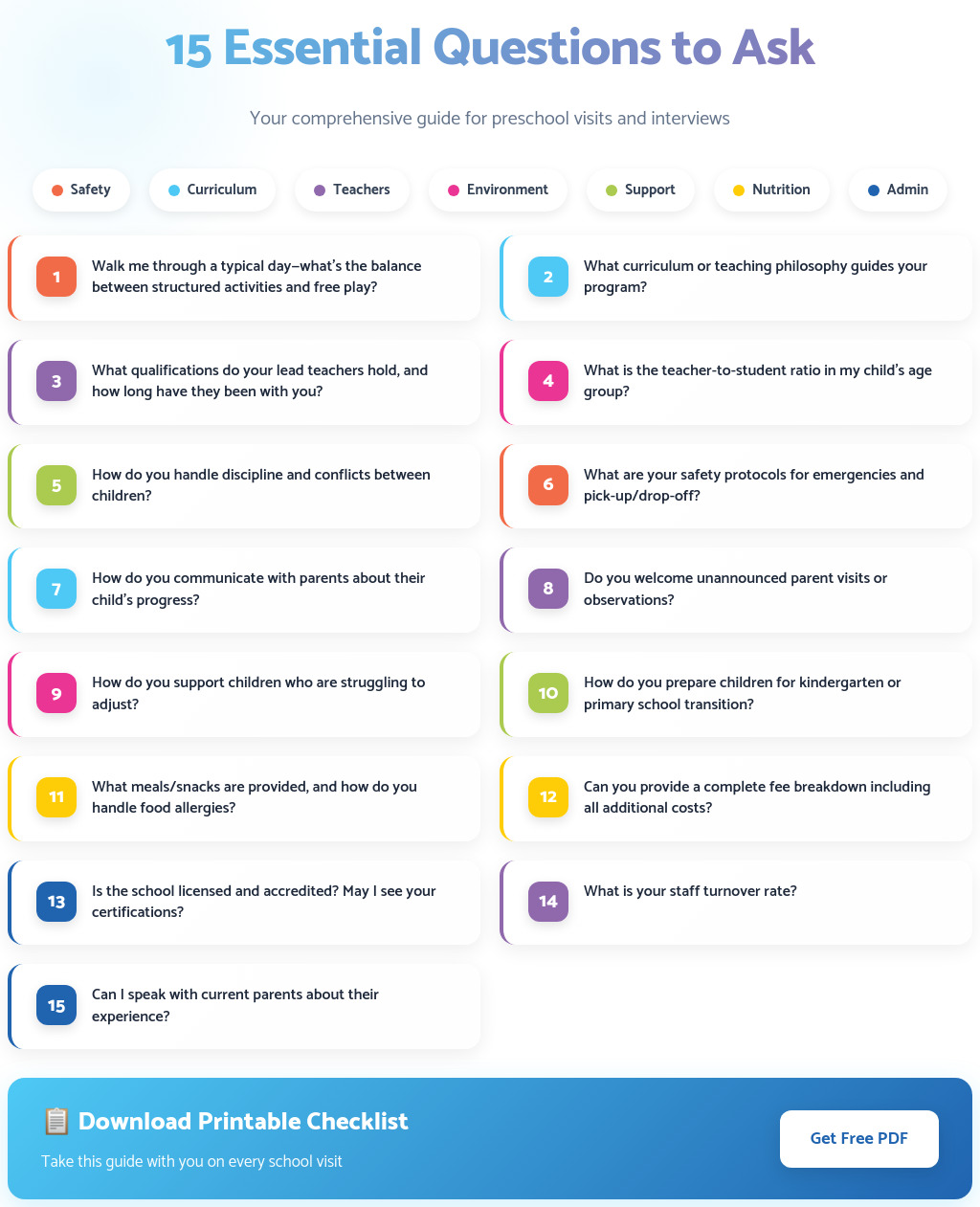
When touring prospective preschools, don’t just admire the facilities, dig deeper with strategic questions. Observation is equally important: watch how teachers interact with children and how children engage with their environment.
- “Walk me through a typical day, what’s the balance between structured activities and free play?”
- “What curriculum or teaching philosophy guides your program?”
- “What qualifications do your lead teachers hold, and how long have they been with you?”
- “What is the teacher-to-student ratio in my child’s age group?”
- “How do you handle discipline and conflicts between children?”
- “What are your safety protocols for emergencies and pick-up/drop-off?”
- “How do you communicate with parents about their child’s progress?”
- “Do you welcome unannounced parent visits or observations?”
- “How do you support children who are struggling to adjust?”
- “How do you prepare children for kindergarten or primary school transition?”
- “What meals/snacks are provided, and how do you handle food allergies?”
- “Can you provide a complete fee breakdown including all additional costs?”
- “Is the school licensed and accredited? May I see your certifications?”
- “What is your staff turnover rate?”
- “Can I speak with current parents about their experience?”
Preschool Evaluation Scorecard: Your Campus Visit Checklist
| Evaluation Factor | Priority Level | What to Look For | Key Questions to Ask |
|---|---|---|---|
| Safety & Security | Critical | CCTV coverage, secure check-in/out procedures, first aid trained staff, hygiene protocols, emergency exits clearly marked | “What are your emergency protocols?” “How do you verify who picks up children?” “Are staff trained in pediatric first aid?” |
| Curriculum & Philosophy | Critical | Recognized framework (EYFS, Montessori, play-based), balance of academics and soft skills, daily schedule visible, age-appropriate activities | “What curriculum guides your program?” “Can I see a typical daily schedule?” “How do you balance play and structured learning?” |
| Teacher Qualifications | Critical | ECE degrees/certifications, ongoing professional development, warm interactions with children, low staff turnover rate | “What qualifications do lead teachers hold?” “How often do teachers attend training?” “What’s your staff turnover rate?” |
| Teacher-Student Ratios | Critical | Ideal ratios: 1:4 (under 2yrs), 1:6 (2yrs), 1:8 (3yrs), 1:10 (4-5yrs). Observe if teachers can give individual attention | “What is the teacher-to-student ratio in my child’s age group?” “How many assistant teachers are in each classroom?” |
| Facilities & Environment | Important | Age-appropriate furniture, organized learning centers, safe outdoor play area, clean bathrooms, adequate lighting and ventilation | “Can I tour all facilities including bathrooms and outdoor areas?” “How often are toys and equipment sanitized?” |
| Program Flexibility | Important | Half-day and full-day options, extended care available, flexible attendance (3-day or 5-day), holiday camp programs offered | “What program options do you offer?” “Is extended care available for working parents?” “Are there holiday programs?” |
| Parent Communication | Critical | Daily updates via app, regular parent-teacher conferences, digital portfolios, open-door policy, responsive to concerns | “How do you communicate daily progress?” “Can parents observe classes?” “How are concerns addressed?” |
| Nutrition & Meals | Important | Balanced meal menus available, allergy management protocols, clean kitchen facilities, healthy eating habits promoted | “Can I see sample menus?” “How do you handle food allergies?” “Are meals prepared on-site or catered?” |
| Cost Transparency | Critical | Clear fee breakdown provided, no hidden costs, refund policy explained, payment schedule flexible | “Can I get a complete fee breakdown?” “What’s included in tuition?” “Are there additional costs for activities or field trips?” |
| Accreditation & Reputation | Important | Licensed by Kemendikbud, international accreditations if applicable, positive parent testimonials, established track record | “Is the school licensed and accredited?” “May I see certifications?” “Can I speak with current parents about their experience?” |
Red Flags to Watch For
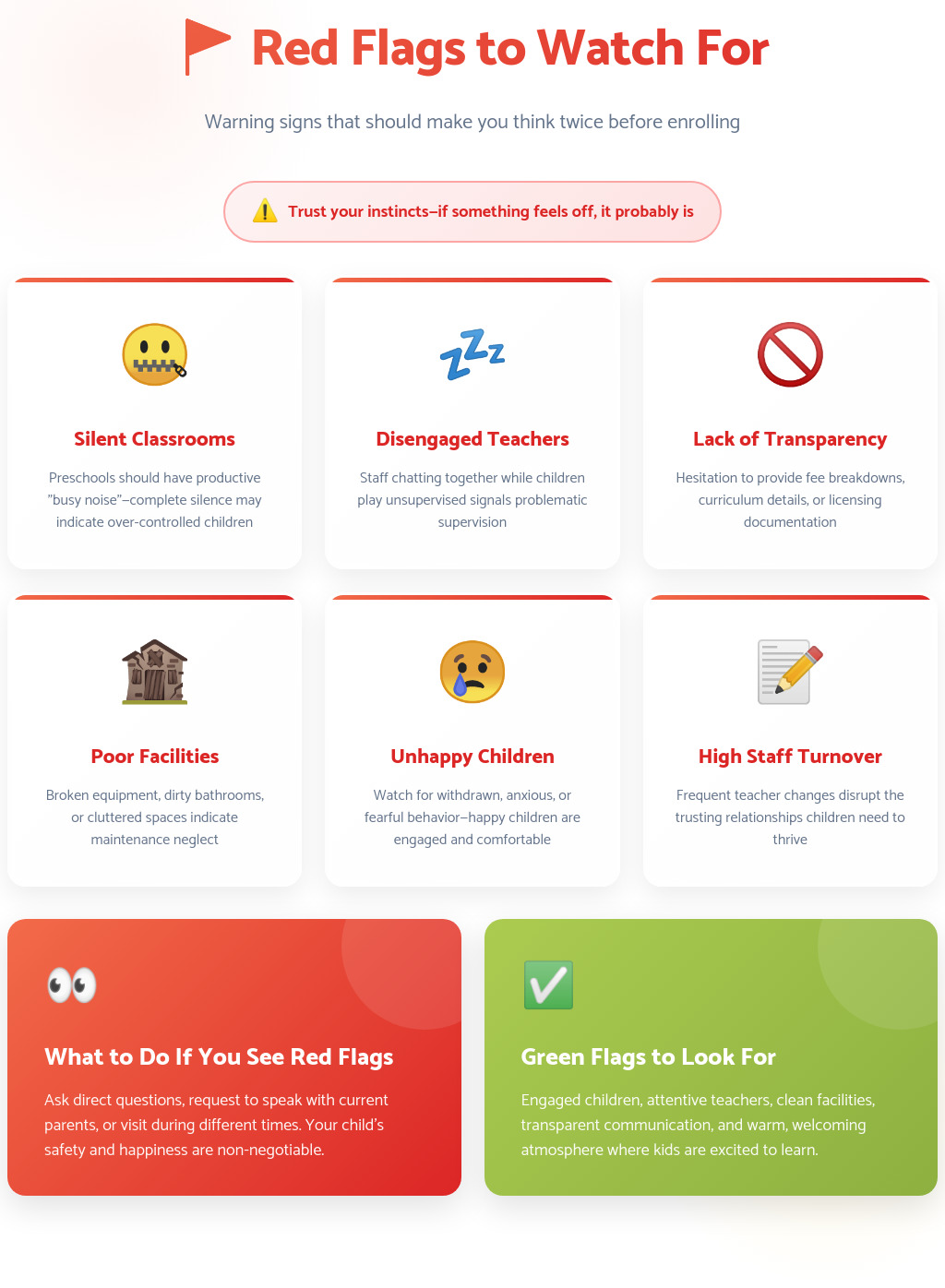
- Silent Classrooms: Preschools should have a productive “busy noise”, silence may indicate over-controlled children.
- Disengaged Teachers: Staff chatting together while children play unsupervised signals problematic supervision.
- Lack of Transparency: Hesitation to provide fee breakdowns, curriculum details, or licensing documentation is concerning.
- Poor Facilities: Broken equipment, dirty bathrooms, or cluttered spaces indicate maintenance neglect.
- Unhappy Children: Watch for withdrawn, anxious, or fearful behavior, happy children are engaged and comfortable.
Making Your Final Decision
After visiting multiple schools, weigh your findings against your family’s priorities. No school is perfect, but some will clearly stand out.
- Trust Your Gut: Did the children look happy? Did teachers seem warm and engaged? Your intuition matters.
- Consider Trial Days: Many quality preschools offer trial classes, the best way to see if your child connects with the environment.
- Talk to Current Parents: Candid feedback from families currently enrolled provides invaluable insight.
- The “Happy Child” Test: Ultimately, the best school is one where your child feels safe, loved, and excited to return.
Why Parents Choose Blue Dolphin PlaySkool
At Blue Dolphin PlaySkool, we understand that choosing a preschool means choosing a partner in your child’s development. Since 2010, we’ve been helping children aged 18 months to 6 years build strong foundations for lifelong success across our campuses in Bali, Jakarta, Yogyakarta, Surabaya, and Serpong.
The MiMaCo Learning Methodology
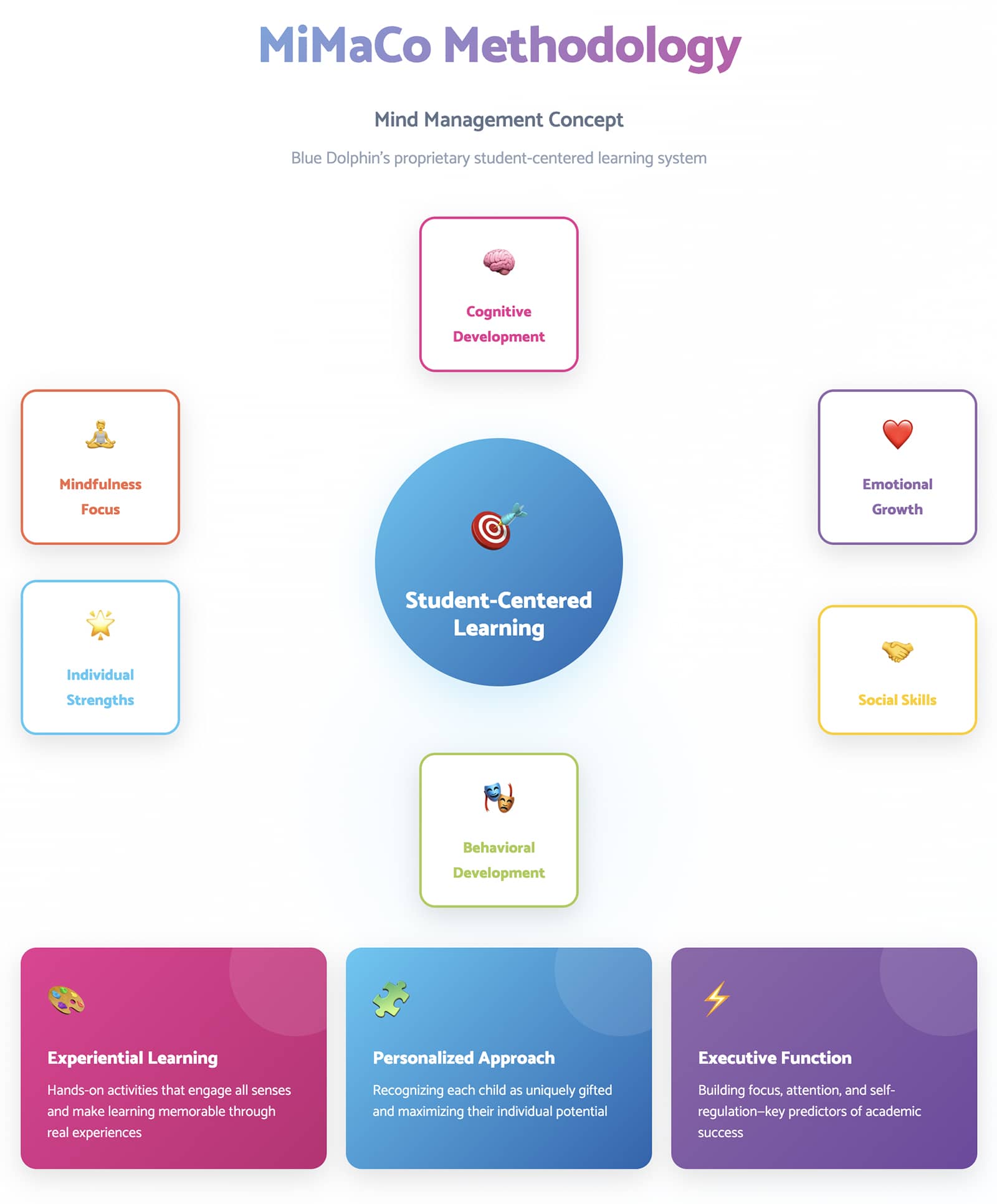
Our proprietary MiMaCo (Mind Management Concept) system provides a student-centered approach that recognizes each child as uniquely gifted. This comprehensive methodology addresses cognitive, social, emotional, and behavioral development through experiential learning, maximizing each child’s potential while nurturing their individual strengths. MiMaCo’s focus on mindfulness enhances children’s focus, attention, and self-regulation, the executive function skills that research identifies as crucial predictors of academic success.
H.E.A.R.T.S. Values Framework
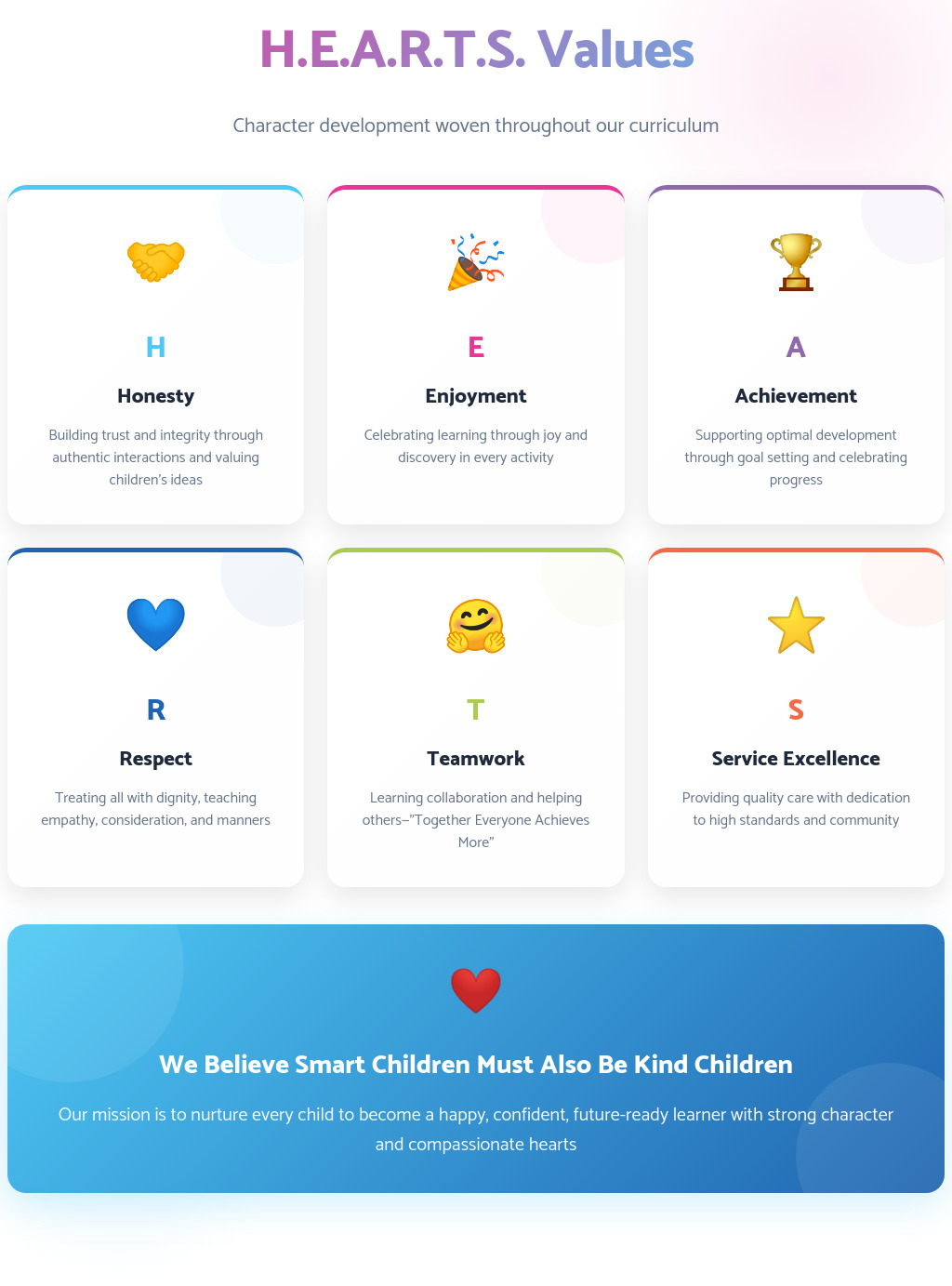
Character development is woven throughout our curriculum through our H.E.A.R.T.S. values, Honesty (building trust and integrity), Enjoyment (celebrating learning), Achievement (optimal development), Respect (treating all with dignity), Teamwork (collaborative success), and Service Excellence (caring for community). We believe smart children must also be kind children.
Programs Tailored to Every Stage
- PlayNest (18 months – 3 years): Safe, nurturing childcare that gives working parents peace of mind while providing age-appropriate developmental stimulation.
- PlaySkool (18 months – 6 years): Our flagship preschool program delivering balanced learning activities through our holistic MiMaCo approach.
- PlayHouse (4 – 6 years): Full-day program combining formal education with enriching after-school activities including cooking, science exploration, and sports.
Educational Excellence Through Partnership
We enhance learning through partnerships with proven educational programs: Jolly Phonics for multi-sensory letter-sound learning, Origo for digital mathematics exploration, and National Geographic Kids for science discovery. Our Littlelives technology platform keeps parents connected with real-time attendance tracking, daily portfolios, and seamless teacher-parent communication.
What Parents Say
“We see lots of improvement in personality and communication skills. They also become more independent in their daily routine, thanks to the encouragement, care, patience, guidance, and great observation of their teachers.”, Parent, Yogyakarta Campus
Your Next Steps
Choosing a preschool is a significant decision, but with the right framework, it becomes a confident one. Use the 10 essential factors as your evaluation checklist, ask strategic questions during visits, trust your observations, and remember that the best fit balances quality education with your child’s happiness.
Ready to see the Blue Dolphin difference? We invite you to schedule a school tour at your nearest campus and experience our MiMaCo methodology firsthand. Meet our passionate teachers, explore our facilities, and see our engaged, happy students in action.
Visit: bluedolphin.arfadia.com
Locations: Bali (Kuta & Puri Gading) | Jakarta Kelapa Gading | Yogyakarta | Surabaya | Serpong
Download our Free Preschool Comparison Checklist to organize your school visits and make the decision that’s best for your family.
Frequently Asked Questions
Q: What should I look for in a preschool?
A: Focus on safety protocols, curriculum quality, teacher qualifications, teacher-student ratios, facilities, program flexibility, communication practices, nutrition, transparent costs, and accreditation. Most importantly, ensure your child feels comfortable and engaged.
Q: How do I choose an international preschool as an expat?
A: Prioritize schools with internationally recognized curriculum frameworks (EYFS, IB), quality English instruction, diverse student populations, and programs supporting children from various cultural backgrounds. Consider whether the curriculum ensures smooth transitions if you relocate to other countries.
Q: What age should my child start preschool?
A: Many programs accept children from 18 months, though readiness varies individually. Quality playgroup programs for ages 2-4 focus on socialization and motor development, while kindergarten programs (ages 4-6) introduce more structured learning. Consult with schools about age-appropriate programs for your child’s developmental stage.
Q: Is expensive tuition worth it?
A: Price doesn’t always correlate with quality. Evaluate value based on teacher qualifications, student-teacher ratios, facilities, curriculum, and outcomes, not tuition alone. A mid-range school with excellent teachers and low ratios may provide better value than a prestigious, expensive school with larger class sizes.
—————
Blue Dolphin PlaySkool
Nurturing Happy, Confident Learners Since 2010
References & Further Reading
This article is based on research from leading authorities in early childhood development:
- CDC Developmental Milestones. U.S. Centers for Disease Control and Prevention. Learn the Signs. Act Early.
- InBrief: Executive Function. Center on the Developing Child at Harvard University. Executive Function Skills for Life and Learning.
- Ready or Not Kindergarten, Here We Come! National Association for the Education of Young Children (NAEYC). School Readiness Resources.
- School Readiness. Williams PG, Lerner MA. Pediatrics. 2019;144(2):e20191766. American Academy of Pediatrics.
- Early Childhood Development. United Nations Children’s Fund (UNICEF). UNICEF Global Programme.
- Activities Guide: Enhancing and Practicing Executive Function Skills. Center on the Developing Child at Harvard University. Practical Activities for Parents.
- Early Childhood Development Data. UNICEF Data Portal. Global ECD Statistics.
This article provides general information about preschool selection. For specific advice about your child’s development and educational needs, please consult with qualified early childhood educators and pediatricians.